Monday, October 30, 2023

Image of a True Disciple: The Gadarene Demoniac


Dear Parish Faithful & Friends in Christ,

One of the most challenging narratives in the Gospels has to be the healing of the Gadarene demoniac (Mk. 5:1-20; MATT. 8:28-34; LK. 8:26-39). This dramatic event which reveals the power of Christ over the demons will appear to the 21st c. mind as either archaic or even primitive. We may listen with respect and sing "Glory to Thee, O Lord, glory to Thee!" upon the completion of the reading, but "wrapping our minds" around such a narrative may leave us baffled if not shaking our heads. The spectacle of a man possessed by many demons, homeless and naked, living among the tombs, chained so as to contain his self-destructive behavior is, to state the obvious, not exactly a sight that we encounter with any regularity. (Although we should acknowledge that behind the walls of certain institutions, we could witness to this day some horrible scenes of irrational and frightening behavior from profoundly troubled and suffering human beings). Add to this a herd of swine blindly rushing over a steep bank and into a lake to be drowned, and we must further recognize the strangeness of this event. This is all-together not a part of our world!

Yet, there is no reason to doubt the veracity of the narrated event, which does appear in three of the Gospels, though with different emphases and details - in fact there are two demoniacs in St. Matthew's telling of the story! It is always instructive to compare the written account of a particular event or body of teaching when found in more than one Gospel. This will cure us of the illusion of a wooden literalism as we will discover how the four evangelists will present their gathered material from the ministry of Jesus in somewhat different forms. As to the Gadarenedemoniac, here was an event within the ministry of Christ that must have left a very strong impression upon the early Church as it was shaping its oral traditions into written traditions that would eventually come together in the canonical Gospels. This event was a powerful confirmation of the Lord's encounter and conflict with, and victory over, the "evil one." The final and ultimate consequence of that victory will be revealed in the Cross and Resurrection.

Whatever our immediate reaction to this passage - proclaimed yesterday during the Liturgy from the Gospel According to St. Luke (8:26-39) - I believe that we can recognize behind the dramatic details the disintegration of a human personality under the influence of the evil one, and the reintegration of the same man's personhood when healed by Christ. Here was a man that was losing his identity to a process that was undermining the integrity of his humanity and leading to physical harm and psychic fragmentation. I am not in the process of offering a psychological analysis of the Gadarene demoniac because, 1) I am ill-equipped to do so; and 2) I do not believe that we can "reduce" his horrible condition to psychological analysis. We are dealing with the mysterious presence of personified evil and the horrific effects of that demonic presence which we accept as an essential element of the authentic Gospel Tradition. The final detail that indicates this possessed man's loss of personhood is revealed in the dialogue between himself and Jesus:

Jesus then asked him, "What is your name?" And he said, "Legion"; for many demons had entered him. (8:30)

To be named in the Bible is to receive a definite and irreducible identity as a person. It is to be "someone" created in the "image and likeness of God." It is the role of the evil one to be a force of disintegration. The "legion" inhabiting the man reveals the loss of his uniqueness, and the fragmentation of his personality. Such a distorted personality can no longer have a "home," which is indicative of our relational capacity as human beings, as it is indicative of stability and a "groundedness" in everyday reality. The poor man is driven into the desert, biblically the abode of demons. Once again, we may stress the dramatic quality of this presentation of a person driven to such a state, but would we argue against this very presentation as false when we think of the level of distortion that accompanies any form of an "alliance" with evil -whether "voluntary or involuntary?" Does anyone remain whole and well-balanced under the influence of evil? Or do we rather not experience or witness a drift toward the "abyss"?

Then we hear a splendid description of the man when he is healed by Christ! For we hear the following once the demons left him and entered into the herd of swine and self-destructed (the ultimate end of all personal manifestations of evil?):

Then the people went out to see what had happened, and they came to Jesus, and found the man from whom the demons had gone, sitting at the feet of Jesus, clothed and in his right mind; and they were afraid. (8:35)

"Sitting at the feet of Jesus, clothed and in his right mind." This is clearly one of the most beautiful descriptions of a Christian who remains as a true disciple of the Master. This is the baptized person who is clothed in a "garment of salvation" and who is reoriented toward Christ, the "Sun of Righteousness." The image here is of total reintegration, of the establishment of a relationship with Christ that restores integrity and wholeness to human life. Also an image of peacefulness and contentment. Our goal is life is to "get our mind right" which describes repentance or that "change of mind" that heals all internal divisions of the mind and heart as it restores our relationship with others. Jesus commands the man "to return to your home, and declare how much God has done for you" (8:39). We, too, have been freed from the evil one "and all his angels and all his pride" in baptism. In our own way, perhaps we too can also proclaim just how much Jesus has done for us.

The healing of the Gadarene demoniac is a challenging narrative, indeed. Yet, even for us in the 21st c. it is an episode in which the Gospel is proclaimed: The "Good News: of the victory of Christ over the "evil one!"


Wednesday, October 25, 2023

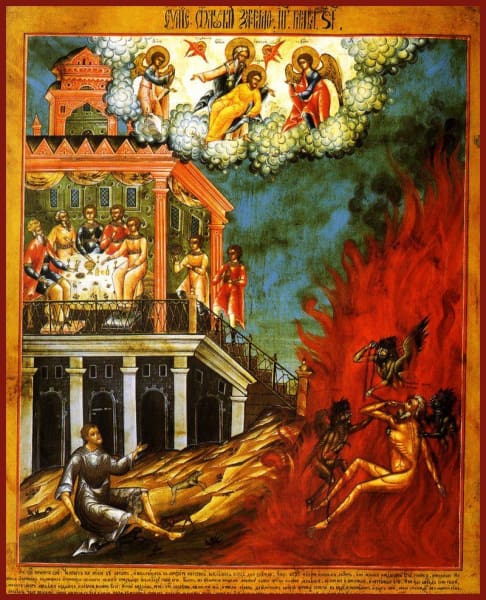
Just Who is the Real Rich Man?


 Dear Parish Faithful & Friends in Christ,


"If they do not hear Moses and the prophets, neither will they be convinced if some one should rise from the dead." (LK. 16:31)


The Parable of Lazarus and the Rich Man is the only parable that has a named character, and the only parable in which Jesus describes the "afterlife." In these two instances it remains unique among the Lord's parables. It is a parable extremely rich in content, with a rather complex structure based upon a "reversal of fortune,"and filled with multiple themes. 

Yet, certainly one of those many themes is quite apparent and revealed with a stark directness: the consequence of ignoring the poor and needy, embodied in Lazarus, the poor man at the gate. (Is he given a name to emphasize this point in a personal and less-forgettable manner, so that his character takes us beyond an anonymous example of the poor?). The rich man in hades (the biblical realm of the dead) bears the consequence of his indifference to Lazarus and his unwillingness to share. 


St. John Chrysostom explored this theme of wealth and poverty with unrivaled insight and depth in his famous series of homilies on this parable (a collection of homilies that now exists in English - On Wealth and Poverty - and which every member of the Church should read). St. John would always challenge the conventional wisdom of his own age, by interpreting the Scriptures in such a way that would turn our accepted values upside down so that we would be able to look at things in a new and startling light. In a famous passage from his homilies, he challenges our conventional notions of what true wealth and true poverty actually are. He does this by asking just who is the real rich man and who is the real poor man:


Let us learn from this man not to call the rich lucky nor the poor unfortunate. Rather, if we are to tell the truth, the rich man is not the one who has collected many possessions but the one who needs few possessions; and the poor man is not the one who has no possessions but the one who has many desires. We ought to consider this the definition of poverty and wealth. So if you see someone greedy for many things, you should consider him the poorest of all, even if he has acquired everyone's money. If, on the other hand, you see someone with few needs, you should count him the richest of all, even if he has acquired nothing.


I rather doubt that this will change the minds of very many of us about the true nature of wealth and poverty. Conventional wisdom - combined with observation and life experience - does tell us that wealth has to do with money, possessions, status and power; and that poverty has to do with lacking any and all of these things. Many of us "deep down" crave to be wealthy, and we certainly fear the specter of poverty. 

Yet, St. John was neither a simpleton nor a naïve dreamer. He knows of the corrosive effect on the wealthy of a life primarily dedicated to more and more acquisition and how this becomes obsessive and compulsive; and he knew many Christians personally that sought a life of simplicity and through that pursuit discovered a different type of wealth that had the presence of God as its source. St. John was also aware of the judgment of God which differs radically from our own limited understanding of the "bigger picture." 

Many people are forced to struggle to makes ends meet - and perhaps dream of hitting the lottery - and can only watch with envy the lifestyles of "the rich and famous" that entice such dreams. Perhaps, then, St. John makes some sense about the obsessive "collection of many possessions," the fulfillment of "many desires" and the effect of being "greedy for many things," and how a "successful" pursuit of this captivating dream can be more impoverishing than enriching. And then St. John got the point of the parable: in some cases it can be too late to change.
 

_________

In case you may be further interested, below are a series of links to other meditations that I have written throughout the years on the Parable of Lazarus and the Rich Man. There is, admittedly, a great deal of overlap and I depend on St. John Chrysostom's remarkable set of homilies on the parable throughout these meditations. But, again, in case you may be interested to read further:

Saturday, October 21, 2023

The Lazarus Basket: Activating the parable for us here and now


 Dear Parish Faithful,

For if he did not give alms to this man who was continually prostrate at his gate, lying before his eyes, whom he had to see every day once or twice or many times as he went in and out ... if, (I say) he did not give alms to this man, who lay in such grievous suffering, and lived in such destitution, or rather for his whole life was troubled by chronic illness of the most serious kind, whom of those he encountered would he ever have been moved to pity?

St. John Chrysostom, Homily 1 on the Rich Man and Lazarus


The Lazarus Basket - For many years now this basket, meant for collecting charity donations, has been aligned with the reading of the Parable of Lazarus and the Rich Man. So, we are very familiar with this tradition at this point in time. For those who are new to the parish, here is the meaning and purpose of this basket which will be next to the Cross for three consecutive Sundays, beginning this coming Sunday:

The collection basket, named after the Lazarus of the parable, is meant to "activate" the parable for us here and now. The rich man passed by poor Lazarus, thereby ignoring his needs. As we venerate the Cross of the Lord following the Liturgy, we represent the rich man who can either respond to Lazarus by placing a donation in the basket; or who can ignore Lazarus by passing by the basket without leaving anything in it (thus acting as the rich man did in the parable). Hopefully, we make that decision with the parable still very much alive in our minds and hearts having just heard it in the Liturgy.

I realize that we just had a basket for the recent seminary appeal. And we are in the process of making our Stewardship appeal for 2024. However, if everyone responds on some level of giving, we can make a substantial collection that will be distributed during both Thanksgiving and Nativity locally for those in need in our parish neighborhood. The parish is growing, so more people than ever are approaching the Cross and thus, the Lazarus basket. If we can give just a bit more, it will prove to be a good response to the Gospel.

To repeat: the Lazarus basket will be by the Cross for three consecutive Sundays, thus giving the entire parish an opportunity to contribute.

Fr. Steven

Wednesday, October 11, 2023

Our Vocation as Christians


Christ before His enemies


Dear Parish Faithful,

"And in Antioch the disciples were first called Christians." (Acts 11:26)

"I want to be a man of the Church. I do not want to be called by the name of some founder of a heresy, but by the name of Christ, and to bear that name which is blessed on the earth. It is my desire, in deed and in spirit, both to be and to be called a Christian."  - Origen (+254)

 
_____

It is not exactly a compliment to be called a Christian in today's world. And it is not simply a matter of the unbelieving world dismissing Christians and the Gospel. "Christian" rhetoric of a most uncharitable, and at times vitriolic kind, is now widely scattered among the battlefields of today's "culture wars." This rhetoric is now no longer shocking, but rather expected from the Christian front. When overly-zealous Christians encounter anything that they fully disagree with in these "culture wars," they will inevitably label it as "demonic" - and make the point loud and clear. That derisively dismissive term has a finality about it, that closes off any further discussion or analysis of the given topic of disagreement. 

In addition, "politicized theology" is just as easily expressed and proven to be divisive within various Christian bodies, at least in America. Loyalty to a political party or to an ideology seems to be more passionately embraced than loyalty to Christ and the Gospel. This state of affairs, widely covered in the press, has only proven to demean and devalue the title of "Christian." Unfortunately, Christians who are not caught up in the "culture wars" or "politicized theology," also bear the brunt of the opprobrium now attached to the title "Christian." It can all get a bit embarrassing. 

In the light of this, there is something very refreshing and inspiring in what Origen says about being called a Christian. For Origen, in the 2nd - 3rd centuries of the Christian era, it was such an honor - and responsibility - to bear the name of Christ. Origen, we know, suffered torture as a confessor for his confession of being a Christian during a time when Christians were persecuted within the confines of the Roman Empire. And it is possible that when the disciples of Christ were "first called Christians," in Antioch, that the title was used disparagingly. To declare oneself a Christian in such an oppressive atmosphere was a courageous act that will potentially inspire others. 

It seems like we have to recapture and rediscover some of the fire and energy with which Origen imparts to the honor of being "called a Christian." The name of Christ "blesses" the earth and just to recover that truth is essential to our commitment to the vocation of bearing His name in the world. Yet, Origen is clear that we must do so "in deed and in spirit." It was just two Sundays ago, that we heard these words during the Liturgy from the Gospel According to St. Luke: "But I say to you that hear, Love your enemies, do good to those who hate you, bless those who curse you, pray for those who abuse you." (Lk. 6:27-28) It my take a lifetime to be able to put that part of Christ's teaching into practice. 

A good deal of the unbelieving world looks for reasons to mock Christians as hypocritical and unloving. Christians, in turn, have a noble obligation to struggle against these unwanted labels, which hardly belong to the 'mind of Christ." Restoring dignity and honor to the name of Christian is a worthy vocation to be pursued in a world in which both Christians and non-Christians seem to be confused and misguided.

Monday, September 25, 2023

Contemporary Classics of Orthodox Literature


Dear Parish Faithful & Friends in Christ,  

"Remember your leaders, those who spoke to you the word of God ..."  - Heb. 13:7


Contemporary Classics of Orthodox Literature

 by Fr. Steven Kostoff

It is my observation that today many Orthodox Christians are reading a good deal of contemporary Orthodox literature - books on spirituality, liturgy, theology and history. These are books that are read immediately upon publication and which are very well promoted - if not well "marketed." A steady Orthodox reading discipline/program is essential in today's world perhaps more than ever. We are so ideologically bombarded from so many disparate quarters, that we need to remember who we are and what we believe! 

I am writing, though, with a particular concern in mind: Perhaps we are only - or mostly only - reading the most contemporary literature. Most of the Orthodox literature that I am now referring to can be accessed on Ancient Faith Radio. There is a circle of well-read authors there who are fairly prolific and have a wide Orthodox reading audience. I am not writing anything against those authors or their books.

However, because I am from an older generation, and have been an Orthodox priest for over forty years now, I want to make a heartfelt plea for the great writers who nurtured me, who nurtured an entire earlier generation or two, and who wrote the classics of twentieth century Orthodox literature. This is a great literature that placed Orthodoxy on the "map" both in America and in Europe and beyond - into Russia and other parts of the world. 

I strongly believe that we need to read these classics of the twentieth century, because these are the very books that served as the foundation for others to build on. These were books that allowed Orthodoxy to emerge from its sheltered ethnic communities; books which revived an abiding and lasting focus on the Fathers of the Church; books which completely restored the apostolic vision of the Liturgy and the Eucharist; and books that penetrated deeply into our genuine spiritual Tradition with the insights and practices that lead us to lives of holiness. 

I repeat: I am not claiming that our newer contemporary literature cannot do that, but our newer authors are standing on the shoulders of the "giants" who prepared the vision that may sustain them. For the sake of balance and wholeness, we must not neglect these classics. It would be a great loss if these books - and their authors - were more-or-less forgotten as the years pass. A further point is that the authors I am about to enumerate were steeped in a centuries-old Orthodox culture. They did not need to be overly defensive defensive, polemical or apologetic. 

This is not a "nostalgia fest" on my part. Of that, I can assure you. I think that as clergy and laity, we need a broad a range of theological grounding as much possible, and again, the classics go a long way in assuring that. (I of course, assume that everyone is reading the Scriptures and Fathers with regularity).

There were four great writers from the Orthodox Tradition that wrote brilliant and compelling books for many decades throughout the twentieth century. I read their works over and over - and over. They have had a lasting effect on me, and I like to think that in my own very modest way, I have applied their vision in my own pastoral ministry, from liturgy to theology. With the exception of Lossky, the other three - especially Frs. Schmemann and Meyendorff - were the key "architects" in establishing the Orthodox Church in America. I had the great privilege of actually knowing, studying under and worshiping with, Frs. Alexander Schmemann and John Meyendorff while a student at St. Vladimir's Seminary (1978-1981), as well as with Fr. Thomas Hopko. An unforgettable experience.

So, here are a few of the authors and books that I would like to highlight and bring to your attention:

+ George Florovsky (1893 - 1979)

His collected works have been published in 13 volumes, I believe, but I would single out:

Vol 1 - Bible, Church, Tradition - An Orthodox Perspective - A collection of essays that provide insight after insight into the meaning and relationship between Scripture and Tradition.

Vol. IV - Creation and Redemption - Another set of brilliant essays that incorporate the works of the Church Fathers in understanding the divine oikonomia from the Incarnation to the Resurrection.

There is a new volume of many never-before translated works, though it is quite expensive. Still, a worthwhile investment. Everything is simply brilliant that is contained in this volume, which also has a great Introduction:

The Patristic Witness of George Florovsky - The Essential Theological Writings 

+ Vladimir Lossky (1903-1958)

The Mystical Theology of the Eastern Church - This book is the Orthodox classic of the twentieth century, written in 1945. It takes some real concentration, but endlessly fascinating and insightful.

The Image and Likeness of God - Essays that cover the whole range of theological, anthropological and Mariological themes.

Orthodox Dogmatics - A comprehensive study of dogmatic subjects by a brilliant theologian who leans heavily on the Church Fathers. 


+ Alexander Schmemann (1921-1983)

For the Life of the World - An absolute "must read" classic.

Great Lent - Considered the best single volume on the subject in the English language by Met. Kallistos Ware.

The Eucharist - Fr. Schmemann's final study of his life-long engagement with the meaning and practice of the Eucharist.

Church, World, Mission - A series of challenging essays about the Orthodox Church facing the challenges of the contemporary world. 


John Meyendorff (1926-1993)

Byzantine Theology - Historical Trends and Doctrinal Themes - A "classic" study of the Byzantine roots of our theological Tradition.

The Byzantine Legacy of the Orthodox Church - A great collection of essays that distinguish between the relative and eternal components of the Byzantine legacy.

Imperial Unity and Christian Divisions - A more detailed look at Church History from the 5th - 8th c. A brilliant work of historical synthesis.


Metropolitan Kallistos Ware (1934-2022)  

We cannot fail to mention him! He comes from a background different than the "big four," but he was a decisive figure in bringing Orthodox literature to the non-Orthodox Christian world.

The Orthodox Church - Still the best one-volume introduction to the Orthodox Church.

The Orthodox Way - a great supplement to The Orthodox Church focusing on what we call Orthodox spirituality. A real favorite!

Sacraments of Healing -  Just published and a further supplement to the two other books by Met. Kallistos. To be read together in this year's upcoming Fall Adult Education Class.

The Inner Kingdom - A collection of endlessly fascinating essays by Met. Kallistos, covering his conversion to Orthodoxy to profound insights into the last judgement - and beyond.


Other contemporary authors that are excellent and who have been writing for some time now, are: John Behr (Becoming Human), Andrew Louth (Introducing Eastern Orthodox Theology), Metropolitan Ilarion (The Orthodox Faith), Peter Bouteneff (How To Be a Sinner), Nona Verna Harrison (The Many-Splendored Image of God). Metropolitan Anthony Bloom (God and Man; Beginning to Pray);  Metropolitan John Zizioulas (Being and Communion), and, of course, Fr. Thomas Hopko (The Orthodox Faith in four volumes), are writers who have rather recently "fallen asleep in the Lord." 

I fully realize that I could be "preaching to the choir," and I apologize if it sounds as if I am implying that you have not read any/some/many of the books above. You may know this literature very well, indeed! And, I do not want to sound patronizing. But, I have been around and reading since the early 1970's(!), so I thought to share some of my own experience with Orthodox literature with those of you who have not been Orthodox for as long. Please accept my advice in that spirit. If anyone would like to pursue this further, a group of us could have a zoom session on this or a related theme.

In Christ,

Fr. Steven