Showing posts with label wealth and poverty. Show all posts

Wednesday, October 29, 2025

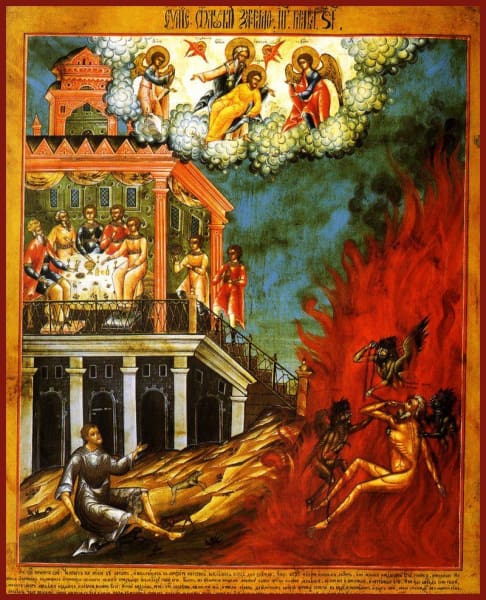
Lazarus and the Rich Man

Source: stjohndc.org

St. John Chrysostom poses the question: How do we evaluate real wealth and real poverty? His answer, as indicated in one of his homilies on the Parable of Lazarus and the Rich Man, will sound jarring to us if we evaluate wealth and poverty by the standards of "this world" alone. Yet, St. John always begins with the Gospel revelation centered in Christ's teaching. The "reversal of fortune" found in the parable extends far beyond the story in the Gospel, and into our own perceptions and priorities:
_____

Let us learn from this man not to call the rich lucky nor the poor unfortunate. Rather, if we are to tell the truth, the rich man is not the one who has collected many possessions but the one who needs few possessions; and the poor man is not the one who has no possessions but the one who has many desires. We ought to consider this the definition of poverty and wealth. So if you see someone greedy for many things, you should consider him the poorest of all, even if he has acquired everyone's money. If, on the other hand, you see someone with few needs, you should count him the richest of all, even if he has acquired nothing.

Monday, December 18, 2023

A Christmas Carol - 'Mankind was my business!'


“Scrooge fell upon his knees, and clasped his hands before his face. 'Mercy!' he cried.” (Excerpt From: Charles Dickens. “A Christmas Carol.” Apple Books. GIF from 'Scrooge', 1951.)


Dear Parish Faithful & Friends in Christ,


The over-all theme of the Parable of the Great Supper, heard last Sunday at the Liturgy, had to do with how being "busy" can easily lead to excuse-making of a dubious kind because we then justify postponing our relationship with God based upon those very excuses. But as Christ said in the parable, the Master of the Supper was not impressed. 

This somehow connects in my mind with a certain literary classic. Over the years I have read A Christmas Carol by Charles Dickens (and seen more than one film version!). For me, one of the most effective passages in the book, is toward the beginning, when the Ghost of Jacob Marley visits Scrooge on Christmas Eve. By this time, the miserly and miserable character of Scrooge has been masterfully etched in by Dickens. And to this day, the name of Scrooge is synonymous with avarice, greed, and a joyless and meaningless accumulation of profit. Earlier, Scrooge had articulated some of the utilitarian philosophy of the 19th c. when he coldly said in reference to the poor and prisoners, "If they would rather die they had better do it, and decrease the surplus population."

The Ghost of Marley returns to haunt Scrooge, but Marley himself is in great torment and anguish. Imprisoned in chains that he cannot free himself of, Marley is doomed to roam the earth as a restless spirit witnessing human suffering that he cannot alleviate because he ignored that suffering selfishly during his time on earth. Of the chains, Marley says:

"I wear the chain I forged in life. I made it link by link, and yard by yard; I girded it on of my own free will, and of my own free will I wore it."


With a deep, bitter regret, Marley then confesses:

"My spirit never walked beyond our counting-house - mark me! - in life my spirit never roved beyond the narrow limits of our money-changing hole; and weary journeys lie before me!... Not to know that no space of regret can make amends for one's life opportunity misused! Yet such was I! Oh! such was I!"


At this point in this somewhat macabre dialogue between the two, Scrooge begins to grope for some signs of hope and relief as he intuitively realizes that Marley is speaking words of warning to him for his cold-hearted scorn for the rest of humanity. When Scrooge protests the working of an unseen providence, by saying "But you were always a good man of business, Jacob," we then hear what may be the most significant - and well-known - passage in this scene:

"Business!" cried the Ghost, wringing its hands again. "Mankind was my business. The common welfare was my business; charity, mercy, forbearance, and benevolence, were all my business. The dealings of my trade were but a drop of water in the comprehensive ocean of my business!" 

It held up its chains at arm's length, as if that were the cause of all its unavailing grief, and flung it heavily upon the ground again. 

"At this time of the rolling year," the spectre said, "I suffer most. Why did I walk through crowds of fellow beings with my eyes turned down, and never raise them to that blessed Star which led the Wise Men to a poor abode! Were there no poor homes to which its light would have conducted me!"

Anticipating the regret of a life not well-lived is a frightening thought. Especially if it comes down to having been too busy!

Good literature is capable of leaving strong indelible images that are much more effective than a well-argued treatise. Dickens' characters were always exaggerated or "larger than life," as we may say. But they then "typify" a great deal about life in the process. 

Besides the necessary business that makes up our lives, and which must be done carefully and responsibly, just what else are we so "busy" with? Does that business also lead us away from charity, mercy, forbearance, and benevolence? Are we presently scurrying around, making sure that we will have a "Merry Christmas," while also turning our eyes downward so that we too cannot "see" the blessed Star that guides us to the Incarnate Christ? Are we going to somehow be able to "fit" the Church into our "Business?" Both the parable from Sunday and Dickens' classic A Christmas Carol raise the issue of our stewardship of time and the Christian truth that "mankind is our business."


Tuesday, December 5, 2023

The Image of Giving in St Nicholas


Dear Parish Faithful,

Yesterday evening, at the Vespers for St. Nicholas at Holy Trinity/St. Nicholas Greek Orthodox Church, there were about thirty parishioners from our parish present for the service. That was more than just a representative group from the parish, I must say! There were five visiting priests, including myself, in addition to the host clergy of Fr. Mark and Fr. John. The service and fellowship went well, and it was a "good evening" spent with other Orthodox Christians. 

Here is a nice anecdote shared by one of our parishioners: When one of our children entered the church and saw the stunning mosaics on the wall, she said: "But how do you kiss those icons?" 

Below is a meditation on the figure of St. Nicholas the Wonderworker, Bishop of Myra in Lycia:


St Nicholas secretly provides dowries for three impoverished sisters, to save them from being sold into slavery by their destitute father.


The Image of Giving in St Nicholas


Dear Fathers, Parish Faithful & Friends in Christ,

There are nineteen days of charity, prayer and fasting left before Christmas... Redeem the time.

Today we commemorate St. Nicholas of Myra in Lycia, the Wonderworker (December 6). There is a certain unresolved tension that accompanies his person and memory: On the one hand, there are few "hard facts" about his life (to the point where many doubt his actual historical existence); and on the other hand, he is clearly one of the most beloved and universally venerated of saints within the Church. It is said that even many Muslims venerate St. Nicholas! A good example of an objective account of the few facts behind the saint's life can be found in a short introductory biographical note concerning St. Nicholas in the book,The Time of the Spirit:

Little is known for certain about the life of St. Nicholas, bishop of Myra in Lycia (Asia Minor). It is believed that he suffered imprisonment during the last major persecution of the Church under Diocletian in the early fourth century, and that he attended the first Ecumenical Council at Nicea in 325. Christian tradition has come to regard him, in the words of an Orthodox hymn, as "an example of faith and an icon of gentleness." (Time of the Spirit, p. 69)

For those interested in the historical background of St. Nicholas, the following note found in The Synaxarion, Vol. II, edited by Hieromonk Makarios of Simonas Petras, may prove to be of real interest:

Since the medieval period, St. Nicholas of Myra has been confused with St. Nicholas of Sion, who founded a monastery not far from Myra at the end of the 5th century. The Vita of the latter has come down to us but the incidents in it have been entirely ascribed to St. Nicholas of Myra, with the result that St. Nicholas of Sion has been forgotten n the hagiographical accounts.... (See The Life of Saint Nicholas of Sion, edited and translated by I. N. P. Sevcenko (Brookline, MA, 1984).


So, even if we are dealing with a "composite figure" when we venerate St. Nicholas the Wonderworker, we nevertheless are given a glimpse into the "mind of the Church" when it comes to an image of a true pastor. A powerful and enduring image of a genuine Christian shepherd has remained within the memory of the Church, regardless of the now unrecoverable "facts" behind the actual history of 4th - 5th c. Asia Minor. It is this "unerring" intuition of the People of God that the faithful respond to up to the present day that remains as a solid foundation upholding all of the wonderful stories that endear us to St. Nicholas. The Church today desperately needs bishops of the type embodied by St. Nicholas. A shepherd who is a "rule of faith and an image of humility" would mean a great deal more to the Christian flock, than legal-minded adherence to canon law. St. Nicholas both protected and interceded for his flock, according to the great Russian Orthodox iconographer, Leonid Uspensky. And he further writes:

"This 'life for others' is his characteristic feature and is manifested by the great variety of forms of his solicitude for men: his care for their preservation, their protection from the elements, from human injustice, from heresies and so forth. This solicitude was accompanied by numerous miracles both during his life and after his death. Indefatigable intercessor, steadfast, uncompromising fighter for Orthodoxy, he was meek and gentle in character and humble in spirit." (The Time of the Spirit, p. 69)


Well-known as St. Nicholas has been, he is perhaps less well-known in today's world. In fact, he may be slowly slipping away from Christian consciousness. Santa Claus, that rather unfortunate caricature of the saintly bishop, clearly has something to do with this. But perhaps the very virtues embodied by this saint are slowly fading from our consciousness. A few weeks back, I wrote a meditation that passed on the name our social and secular world has "earned" for itself through its rampant commercialization of Christmas - and that is Getmas. The author who coined this new term - I forget his name - claims it came to him based on a conversation he had had with a good friend about the "spirit of Christmas." The friend of our author said that Christmas was about "getting things." When the author countered by saying, "I thought Christmas was about giving," the friend quickly retorted: "Sure, people are supposed to give me things!" Out of this sad exchange came the unfortunate, but accurate, Getmas.

St. Nicholas was about the proper understanding of "giving." Perhaps the most enduring quality of his image is that of giving to children in need. Our children learn that those who already "have" more are those who will yet "get" more. And that is because they are taught this by their parents who yield to their demands. So we persist in widening the gap of imbalance between the "haves and "have-nots" without too many pangs of (Christian) conscience. St. Nicholas wanted to restore a sense of balance, and so he looked first to those who were in need, so that they could also taste some childlike happiness from receiving an unexpected gift. In a simple manner, this imitates the giving of God Who gave us Christ at a time when everyone - rich and poor alike - were impoverished through sin and death. 

I sometimes fantasize that an ideal celebration of Christmas would find a relatively affluent family making sure that they spent more on those in need than on themselves. If Christianity is indeed the "imitation of the divine nature" as St. Gregory of Nyssa once said, then that need not necessarily be such an unrealistic idea. I do not believe that I have ever actually done that, so I convict myself through the very thought. Yet, I am convinced that our children would respond with an eager spirit of cooperation if properly prepared for some approximation of that ideal. Why should it be otherwise if, according to the Apostle Paul, Christ said that it is more blessed to give than to receive?

Once again, just a thought based upon the image of St. Nicholas the Wonderworker.


Wednesday, October 25, 2023

Just Who is the Real Rich Man?


 Dear Parish Faithful & Friends in Christ,


"If they do not hear Moses and the prophets, neither will they be convinced if some one should rise from the dead." (LK. 16:31)


The Parable of Lazarus and the Rich Man is the only parable that has a named character, and the only parable in which Jesus describes the "afterlife." In these two instances it remains unique among the Lord's parables. It is a parable extremely rich in content, with a rather complex structure based upon a "reversal of fortune,"and filled with multiple themes. 

Yet, certainly one of those many themes is quite apparent and revealed with a stark directness: the consequence of ignoring the poor and needy, embodied in Lazarus, the poor man at the gate. (Is he given a name to emphasize this point in a personal and less-forgettable manner, so that his character takes us beyond an anonymous example of the poor?). The rich man in hades (the biblical realm of the dead) bears the consequence of his indifference to Lazarus and his unwillingness to share. 


St. John Chrysostom explored this theme of wealth and poverty with unrivaled insight and depth in his famous series of homilies on this parable (a collection of homilies that now exists in English - On Wealth and Poverty - and which every member of the Church should read). St. John would always challenge the conventional wisdom of his own age, by interpreting the Scriptures in such a way that would turn our accepted values upside down so that we would be able to look at things in a new and startling light. In a famous passage from his homilies, he challenges our conventional notions of what true wealth and true poverty actually are. He does this by asking just who is the real rich man and who is the real poor man:


Let us learn from this man not to call the rich lucky nor the poor unfortunate. Rather, if we are to tell the truth, the rich man is not the one who has collected many possessions but the one who needs few possessions; and the poor man is not the one who has no possessions but the one who has many desires. We ought to consider this the definition of poverty and wealth. So if you see someone greedy for many things, you should consider him the poorest of all, even if he has acquired everyone's money. If, on the other hand, you see someone with few needs, you should count him the richest of all, even if he has acquired nothing.


I rather doubt that this will change the minds of very many of us about the true nature of wealth and poverty. Conventional wisdom - combined with observation and life experience - does tell us that wealth has to do with money, possessions, status and power; and that poverty has to do with lacking any and all of these things. Many of us "deep down" crave to be wealthy, and we certainly fear the specter of poverty. 

Yet, St. John was neither a simpleton nor a naïve dreamer. He knows of the corrosive effect on the wealthy of a life primarily dedicated to more and more acquisition and how this becomes obsessive and compulsive; and he knew many Christians personally that sought a life of simplicity and through that pursuit discovered a different type of wealth that had the presence of God as its source. St. John was also aware of the judgment of God which differs radically from our own limited understanding of the "bigger picture." 

Many people are forced to struggle to makes ends meet - and perhaps dream of hitting the lottery - and can only watch with envy the lifestyles of "the rich and famous" that entice such dreams. Perhaps, then, St. John makes some sense about the obsessive "collection of many possessions," the fulfillment of "many desires" and the effect of being "greedy for many things," and how a "successful" pursuit of this captivating dream can be more impoverishing than enriching. And then St. John got the point of the parable: in some cases it can be too late to change.
 

_________

In case you may be further interested, below are a series of links to other meditations that I have written throughout the years on the Parable of Lazarus and the Rich Man. There is, admittedly, a great deal of overlap and I depend on St. John Chrysostom's remarkable set of homilies on the parable throughout these meditations. But, again, in case you may be interested to read further:

Saturday, October 21, 2023

The Lazarus Basket: Activating the parable for us here and now


 Dear Parish Faithful,

For if he did not give alms to this man who was continually prostrate at his gate, lying before his eyes, whom he had to see every day once or twice or many times as he went in and out ... if, (I say) he did not give alms to this man, who lay in such grievous suffering, and lived in such destitution, or rather for his whole life was troubled by chronic illness of the most serious kind, whom of those he encountered would he ever have been moved to pity?

St. John Chrysostom, Homily 1 on the Rich Man and Lazarus


The Lazarus Basket - For many years now this basket, meant for collecting charity donations, has been aligned with the reading of the Parable of Lazarus and the Rich Man. So, we are very familiar with this tradition at this point in time. For those who are new to the parish, here is the meaning and purpose of this basket which will be next to the Cross for three consecutive Sundays, beginning this coming Sunday:

The collection basket, named after the Lazarus of the parable, is meant to "activate" the parable for us here and now. The rich man passed by poor Lazarus, thereby ignoring his needs. As we venerate the Cross of the Lord following the Liturgy, we represent the rich man who can either respond to Lazarus by placing a donation in the basket; or who can ignore Lazarus by passing by the basket without leaving anything in it (thus acting as the rich man did in the parable). Hopefully, we make that decision with the parable still very much alive in our minds and hearts having just heard it in the Liturgy.

I realize that we just had a basket for the recent seminary appeal. And we are in the process of making our Stewardship appeal for 2024. However, if everyone responds on some level of giving, we can make a substantial collection that will be distributed during both Thanksgiving and Nativity locally for those in need in our parish neighborhood. The parish is growing, so more people than ever are approaching the Cross and thus, the Lazarus basket. If we can give just a bit more, it will prove to be a good response to the Gospel.

To repeat: the Lazarus basket will be by the Cross for three consecutive Sundays, thus giving the entire parish an opportunity to contribute.

Fr. Steven

Thursday, December 8, 2022

The Image of Giving in St Nicholas


St Nicholas provides gifts for three daughters to save them from poverty and harm.


Dear Fathers, Parish Faithful & Friends in Christ,


There are nineteen days of charity, prayer and fasting left before Christmas... Redeem the time.


Today we commemorate St. Nicholas of Myra in Lycia, the Wonderworker (December 6). There is a certain unresolved tension that accompanies his person and memory: On the one hand, there are few "hard facts" about his life (to the point where many doubt his actual historical existence); and on the other hand, he is clearly one of the most beloved and universally venerated of saints within the Church. It is said that even many Muslims venerate St. Nicholas! A good example of an objective account of the few facts behind the saint's life can be found in a short introductory biographical note concerning St. Nicholas in the book,The Time of the Spirit:

Little is known for certain about the life of St. Nicholas, bishop of Myra in Lycia (Asia Minor). It is believed that he suffered imprisonment during the last major persecution of the Church under Diocletian in the early fourth century, and that he attended the first Ecumenical Council at Nicea in 325. Christian tradition has come to regard him, in the words of an Orthodox hymn, as "an example of faith and an icon of gentleness." (Time of the Spirit, p. 69)


For those interested in the historical background of St. Nicholas, the following note found in The Synaxarion, Vol. II, edited by Hieromonk Makarios of Simonas Petras, may prove to be of real interest:

Since the medieval period, St. Nicholas of Myra has been confused with St. Nicholas of Sion, who founded a monastery not far from Myra at the end of the 5th century. The Vita of the latter has come down to us but the incidents in it have been entirely ascribed to St. Nicholas of Myra, with the result that St. Nicholas of Sion has been forgotten n the hagiographical accounts.... (See The Life of Saint Nicholas of Sion, edited and translated by I. N. P. Sevcenko (Brookline, MA, 1984).


So, even if we are dealing with a "composite figure" when we venerate St. Nicholas the Wonderworker, we nevertheless are given a glimpse into the "mind of the Church" when it comes to an image of a true pastor. A powerful and enduring image of a genuine Christian shepherd has remained within the memory of the Church, regardless of the now unrecoverable "facts" behind the actual history of 4th - 5th c. Asia Minor. It is this "unerring" intuition of the People of God that the faithful respond to up to the present day that remains as a solid foundation upholding all of the wonderful stories that endear us to St. Nicholas. The Church today desperately needs bishops of the type embodied by St. Nicholas. A shepherd who is a "rule of faith and an image of humility" would mean a great deal more to the Christian flock, than legal-minded adherence to canon law. St. Nicholas both protected and interceded for his flock, according to the great Russian Orthodox iconographer, Leonid Uspensky. And he further writes:

This 'life for others' is his characteristic feature and is manifested by the great variety of forms of his solicitude for men: his care for their preservation, their protection from the elements, from human injustice, from heresies and so forth. This solicitude was accompanied by numerous miracles both during his life and after his death. Indefatigable intercessor, steadfast, uncompromising fighter for Orthodoxy, he was meek and gentle in character and humble in spirit. (The Time of the Spirit, p. 69)


Well-known as St. Nicholas has been, he is perhaps less well-known in today's world. In fact, he may be slowly slipping away from Christian consciousness. Santa Claus, that rather unfortunate caricature of the saintly bishop, clearly has something to do with this. But perhaps the very virtues embodied by this saint are slowly fading from our consciousness. A few weeks back, I wrote a meditation that passed on the name our social and secular world has "earned" for itself through its rampant commercialization of Christmas - and that is Getmas. The author who coined this new term - I forget his name - claims it came to him based on a conversation he had had with a good friend about the "spirit of Christmas." The friend of our author said that Christmas was about "getting things." When the author countered by saying, "I thought Christmas was about giving," the friend quickly retorted: "Sure, people are supposed to give me things!" Out of this sad exchange came the unfortunate, but accurate, Getmas.

St. Nicholas was about the proper understanding of "giving." Perhaps the most enduring quality of his image is that of giving to children in need. Our children learn that those who already "have" more are those who will yet "get" more. And that is because they are taught this by their parents who yield to their childish demands. So we persist in widening the gap of imbalance between the "haves and "have-nots" without too many pangs of (Christian) conscience. St. Nicholas wanted to restore a sense of balance, and so he looked first to those who were in need, so that they could also taste some childlike happiness from receiving an unexpected gift. In a simple manner, this imitates the giving of God Who gave us Christ at a time when everyone - rich and poor alike - were impoverished through sin and death. 

I sometimes fantasize that an ideal celebration of Christmas would find a relatively affluent family making sure that they spent more on those in need than on themselves. If Christianity is indeed the "imitation of the divine nature" as St. Gregory of Nyssa once said, then that need not necessarily be such an unrealistic idea. I do not believe that I have ever actually done that, so I convict myself through the very thought. Yet, I am convinced that our children would respond with an eager spirit of cooperation if properly prepared for some approximation of that ideal. Why should it be otherwise if, according to the Apostle Paul, Christ said that it is more blessed to give than to receive?

Once again, just a thought based upon the image of St. Nicholas the Wonderworker.


Wednesday, November 23, 2022

Becoming Rich Toward God


Icon of the Parable of the Rich Man and his barns

Dear Parish Faithful & Friends in Christ,

At the Divine Liturgy this past Sunday, we heard the Parable of the Rich Fool/Landowner. This is a relatively short parable, so I will simply present what we will read at last Sunday's Liturgy:

And he told them a parable, saying, "The land of a rich man brought forth plentifully, and he thought to himself, 'What shall I do, for I have nowhere to store my crops?' And he said, 'I will do this: I will pull down my barns, and build larger ones, and there I will store all my grain and my goods. And I will say to my soul, Soul, you have ample goods laid up for many years; take your ease, eat, drink, be merry.' But God said to him, 'Fool! This night your soul is required of you; and the things your have prepared, whose will they be?' So is he who lays up treasure for himself, and is not rich toward God." (LK. 12:16-21)


Whenever I hear this particular parable, I think of the words of Tevye the Dairyman in Shalom Aleichem's delightful Yiddish stories about that warm and attractive character. (Also, of course, the main character in the musical "Fiddler on the Roof"). In his musing about God one day, Tevye said: "The more man plans, the harder God laughs." Profound theological thought from a poor dairyman!

It is hard to recall a more straightforward parable in terms of its over-all meaning and intent. The Lord is here speaking of the inevitability and unavoidability of impending death. Death is universal and ubiquitous. And it remains the great equalizer between rich and poor. More specifically, though, the Lord is here dramatizing an unexpected death, one that catches a person totally unprepared and thus rendered a "fool" in the process. The rich landowner's foolishness is revealed in the fact that he had forgotten about God in his pursuit of his "treasure." His forgetfulness is his foolishness. 

There is no indication that the landowner was a particularly sinful person. He may have even seemed pious and God-fearing on the surface. But Christ often specifically warns against surface appearances, or what we call "lip service" to God, while the heart is actually quite distant. Then again, the word sin, from the Gk. amartia, actually means "missing the mark." So, while a person may refrain from committing sinful acts, that same person can be completely "missing the mark" when it comes to a real relationship with God. One can have social status and be totally lost at the same time. The rich landowner reached a point where he began to evaluate everything in life based on the "self" and not on God. His "portfolio building" resulted in an impoverished relationship with God. 

Universal truths are often taken for granted or limited to banal platitudes of recognition. This is probably the most true when we speak of our own impending deaths. It is so true, that that very truth has lost any revelatory dimension. There is also the unconscious denial and the rationalizations that we use to "cope" with the hard truth of death. And we cannot spend our time living in fear of an unexpected death. That would only paralyze our capacity for living. Yet, how many human beings throughout the world will this very day experience what the rich landowner of the parable did! A "cardiac episode," a fatal accident, victimization through a horrific crime. This is the "stuff" of daily living. And these things will happen to countless human beings this very day. A Christian needs to have a realistic awareness of precisely such possibilities. But beyond such a realistic awareness, is hopefully a life rich toward God.

This parable is not about creating a sense of fear or trembling in the face of death. Our Christian hope is meant to liberate us of just such anxiety and fear. However, I believe that we can speak of a "warning" given to us by the Lord. Or perhaps a call to vigilance and preparedness. Of setting our "priorities" in order, as we may say today. We need not be so swept up in our activities and pursuits that we forget God in the process. There is no real excuse for that. Such an outcome renders our "successes" null and void. When we inevitably die and leave behind everything that we have accumulated, we can either hear the words, "Fool!" as in the parable; or "Well done, good and faithful servant!" According to Christ this will depend on whether or not we spent a lifetime trying to get "rich towards God."

Fr. Steven


Thursday, October 27, 2022

Encountering Lazarus


*For three consecutive Sundays, we always have the so-called "Lazarus Basket" by the Cross once we read the Parable of Lazarus and the Rich Man. For those who are new to the parish, perhaps this older meditation may be helpful in explaining the meaning and purpose of that basket.


Dear Parish Faithful & Friends in Christ,

I would like to present a point that I made somewhat forcefully in last Sunday's homily. We heard the Parable of Lazarus and the Rich Man (LK. 16:19-31). A wonderful parable, indeed, but a frightening one as Christ describes the torments of Hades/Hell for those who refuse to practice charity in this life. The "rich man" dressed well and ate well, according to the parable (16:19). But yet he ignored Lazarus who lay outside his gate (on a daily basis?). Lazarus, of course, was not only poor, but he was "full of sores," and seemingly at a near-starvation level, because he would have been content with whatever "fell from the rich man's table" (16:20-21). 

Upon their respective deaths, there was a staggering "reversal of fortune." Lazarus "was carried by the angels to Abraham's bosom" (16:22); but the nameless (not an insignificant detail) rich man was delivered to Hades, the shadowy realm of death where the presence of God cannot be enjoyed. Conscious and tormented by his condition, and reminded by the Lord that his indifference to Lazarus put him there: "Son, remember that you in your lifetime received your good things, and Lazarus in like manner evil things" (16:25), the rich man languishes in agony and regret. And it is too late to repent so that he can come over to the bosom of Abraham, a clear image of paradise: "between us and you a great chasm has been fixed, in order that those who would pass from here to you may not be able, and none may cross from there to us." (16: 26)

It is difficult to determine just how much in a parable can be applied in a doctrinal manner to the mystery of the judgment and the world to come; but nevertheless this parable should have our undivided attention when it comes to our charitable side when contemplating our impending judgment. (There is, of course, the Parable of the Last Judgment in MATT. 25:31-46, read right before the beginnng of Great Lent). We may read the parable as a warning or as an encouragement, but the lesson remains the same. A lack of charity among those who have the means to practice it, reveals an indifference that leaves one unprepared for the joy of God's presence in the age to come.

We hardly encounter a Lazarus type in our everyday lives. We are protected from such encounters. The appeal to our charitable side comes through less direct sources - the mail, audio communication, word-of-mouth, but also in our churches. We periodically have collections for the poor and needy, for victims of natural disasters and the like. This appeal is usually in the form of a basket that is placed by the Cross, so that after the Liturgy, we may come forward, kiss the Cross, and place our contribution in the basket. 

Here, then, is how I see this parable being actualized - made present - in our own lives, at least periodically. The basket, or basket-holder, represents Lazarus, and each one of us represents the rich man. When we go by the basket, we go right past Lazarus. Do we stop and attend to the needs of Lazarus, or do we pass him by as did the rich man? The description of being "rich" is quite relative, for we are all well-clothed and well-fed as was the rich man. We can always put "something' in the basket (beyond what would honestly be deemed a mere token gesture). The right question, therefore, is not: "Can I afford to put something in the basket?" It is: "Can I afford not to put something in the basket in the light of Christ's parable of Lazarus and the Rich Man?" Or, is it possible to kiss the Cross of our Savior, and then walk right by "Lazarus?" Such a thought should strike our conscience, open our hearts - and then our pockets or purses.

We can hardly respond to every appeal that comes our way. We have to make choices based on some discernment. I am raising the point of enjoying our Lord's hospitality toward us in the Eucharistic liturgy, because He made Himself poor so that we could be made rich in Christ Jesus (II COR. 8:9) - a saving event actualized whenever we celebrate the Liturgy. Lazarus can be in our midst also, in one form or another. It may take some sympathetic imagination to "see" him in a mere basket by the Cross, but hopefully the parable will convince us that the way of the rich man is not consistent with the gifts of God that we enjoy in such abundance.


Monday, October 24, 2022

A Radical Critique of Selfishness - Lazarus and the Rich Man


Icon of the parable of Lazarus and the Rich Man

Dear Parish Faithful,


“And as for what fell among the thorns, they are those who hear, but as they go on their way they are choked by the cares and riches and pleasures of life, and their fruit does not mature.” (LK. 8:14)

There is an interior connection between the Parable of the Sower and the Parable of Lazarus and the Rich Man (LK. 16:19-31), heard yesterday at the Divine Liturgy. For the “rich man” of the parable is the embodiment of a person who has been “choked by the cares and riches and pleasures of life,” as described in the Parable of the Sower. Brushing aside the teaching of the Torah, and the Jewish emphasis on charity as one of the great acts of true piety, the rich man remained coldly indifferent to poor Lazarus who was clearly visible at his very gate. Preoccupied with fine linen and sumptuous feasting (v. 19), the rich man was scarcely prepared in his heart to alleviate the sufferings of Lazarus, sufferings that were exemplified by the dogs that licked his sores (v. 20). Such indifference is frightening when seen in the light of the many scriptural admonitions that either chastise the neglect of the poor: “He who closes his ear to the cry of the poor will himself cry out and not be heard;” or encourage his care: “He who is kind to the poor lends to the Lord, and he will repay him for his deed.” (PROV. 21:13; 19:17)

And the severity of the consequences of such neglect of the poor is vividly described in the parable’s “reversal of fortune,” with the rich man languishing in hades, unable to be relieved of his torment there. The contrast of his fate and that of Lazarus being carried into the “bosom of Abraham” by a heavenly escort is striking. (v. 22-23) 

The Parable of Lazarus and the Rich Man was delivered with the Pharisees in mind, for right before Jesus proclaimed the parable, we hear this unflattering description of the Pharisees:  “The Pharisees who were lovers of money, heard all this, and they scoffed at him. But he said to them, ‘You are those who justify yourselves before men, but God knows your hearts; for what is exalted among men is an abomination in the sight of God’.” (LK. 16:14-15) Whatever or whoever may have prompted the words of the Lord during his ministry, our concern now is with our own attitude and treatment of the poor. To think or believe otherwise is to fail to “hear” the parable as it is proclaimed today for our chastisement or encouragement. The words of the Lord – the “Gospel truth” – cannot be properly assessed within the narrow limits of any political allegiances – Democrat or Republican; nor even of a wider-scoped ideology – liberal or conservative. The Gospel transcends these categories as something far greater and infinitely more demanding of our allegiance. 

At a time when neither political parties nor even political ideologies existed or had any real impact on the prevailing cultural or social assumptions of the time, St. John Chrysostom (+407) delivered a series of brilliant homilies on the Parable of Lazarus and the Rich Man. (These seven homilies now exist in English translation under the title on Wealth and Poverty). With his impressive knowledge of the Scriptures; his unmatched rhetorical skills; but most importantly his profound zeal for the moral and ethical teaching of the Gospel; St. John offered a radical critique of selfishness and a radical exhortation to overcome such selfishness for the sake of the poor. Challenging conventional notions of what theft is, he famously expanded its definition by meditating deeply on the parable at hand:

I shall bring you testimony from the divine Scriptures, saying that not only the theft of others’ goods but also the failure to share one’s own goods with others is theft and swindle and defraudation. What is this testimony? Accusing the Jews by the prophet, God says, ‘The earth has brought forth her increase, and you have not brought forth your tithes; but the theft of the poor is in your houses.’ (MAL. 3:8-10) Since you have not given the accustomed offering, He says, you have stolen the goods of the poor. He says this to show the rich that they hold the goods of the poor even if they have inherited them from their fathers or no matter how they have gathered their wealth. And elsewhere the Scripture says, ‘Deprive not the poor of his living.’ (SIR. 4:1) To deprive is to take what belongs to another; for it is called deprivation when we take and keep what belongs to others. By this we are taught that when we do not show mercy, we will be punished just like those who steal. For our money is the Lord’s, however we may have gathered it. If we provide for those in need, we shall obtain great plenty. This is why God has allowed you to have more; not for you to waste on prostitutes, drink, food, expensive clothes, and all the other kinds of indulgence, but for you to distribute to those in need … If you are affluent, but spend more than you need, you will give an account of the funds which were entrusted to you … For you have obtained more than others have, and you have received it, not to spend it for yourself, but to become a good steward for others as well. (On Wealth and Poverty, homily two)


This is a radical teaching, though again not based on any particular social or political philosophy. For St. John the “true philosophy” was adherence to the Gospel. St. John is primarily concerned with uncovering the meaning and implications of what we discover in the Scriptures. If that is challenging to the point of seeming “impossible’” or of least taking us way out of our “comfort zones,” then rather than “soft-pedaling” the Gospel message, St. John would continue in the hope of inspiring us to strengthen our efforts and to put on “the mind of Christ.”


Monday, February 28, 2022

Lives Worth Judging


Dear Parish Faithful & Friends in Christ,


As we draw closer to the beginning of Great Lent – at least for Orthodox Christians – we are able to set our Lenten efforts against the background of the Last Judgment, thus giving us the “big picture” within which we live our lives and determine our personal destinies. 

The Gospel read at the Eucharistic Liturgy just this last Sunday was that of the Discourse on the Last Judgment (MATT. 25:31-46). Therefore, the second Sunday before Great Lent is also called the Sunday of the Last Judgment. In highly symbolic form and with awesome imagery, the Lord speaks of His own Parousia as the glorified Son of man at the end of time and reveals to us that this will be a time of judgment. And this judgment will lead to separation.

The “sheep” (the saved) will be placed on the right hand, and the “goats” (the lost) on the left hand of the eternal Throne of God. This, in turn, will reveal the “quality” of our lives, though not in the way in which we today use the term “quality of life.” We will be confronted with the question as to how well we served the Lord by how well we served the “least” of His brethren: “Truly, I say to you, as you did it to one of the least of these brethren, you did it to me” (MATT. 25:40).

These least are the hungry, the thirsty, the stranger, the naked, the sick and the prisoner. How many of us have to admit that these are precisely the people that we neglect? The fact that society removes such people from our sight does not offer a very reassuring excuse for our neglect. It simply make it more convenient and less troubling for our consciences. Sadly, this may point to one of the most glaring of “disconnects” between the Gospel and our Christian lives, expressed in the following hymn:

Why do you not think of the fearful hour of death? Why do you not tremble at the dread judgment seat of the Savior? What defense then will you make, or what will you answer? Your works will be there to accuse you; your actions will reproach you and condemn you. O my soul, the time is near at hand; make haste before it is too late, and cry aloud in faith: 'I have sinned, O Lord, I have sinned against you; but I know your love for humanity and Your compassion. O good Shepherd deprive me not of a place at Your right hand in Your great glory'. (Vespers, Sunday of the Last Judgment)


I, for one, am not ready to dismiss this hymn as excessively rhetorical, overly pessimistic, or unfairly harsh in its outlook. It is rather a sober and honest plea calling us to repentance and the re-direction of our lives. It further reminds us that it is never too late. And that the Good Shepherd will place us upon His shoulders to the accompaniment of rejoicing angels in heaven over our repentance.

“God is love” (I JN. 4:8). And yet God is demanding. If God “so loved the world that He gave His only Son” to die on the Cross for our redemption, then God expects us to approach and treat others with the same love. This is a love expressed in action and in giving, and is not to be confused with emotions or feelings.

We are all outcasts and alienated from God based upon the primordial sin of Adam, and yet God did not forget us or abandon us. “You were bought with a price” (I COR. 6:20). If we are indeed to “imitate the divine nature” as St. Gregory of Nyssa taught, then we could convincingly say that God expects us to “perform” according to the full capacity of our human nature made in the “image and likeness of God.” All the more plausible and possible because our fallen human nature has been renewed in and through the Death and Resurrection of Christ. Our rescue from a condition of “ontological poverty” is meant to arouse in us a desire to rescue “the least of these” from the impoverishing conditions of a fallen world.

Simultaneously with the external history of our lives there is occurring the internal history of our hearts. The outer life is more readily open to being accurately recorded, from the date of our birth to the date of our death and the significant events in between that make up our personal histories. What is happening within our hearts is far more difficult to record, because the human heart is deep and mysterious.

Yet the prophecy of the Last Judgment, testing the direction of our hearts, raises some very real questions: On what we call the “spiritual level,” is our heart expanding or contracting? Is it growing larger or smaller? Is it becoming more generous or more grasping? Is it letting the neighbor in, or keeping the neighbor out? Is it, as the years move inexorably forward, embracing God and neighbor, or is it shrinking in self-protection? These are questions to explore as we move into the Lenten season.

If our lives are worth living, then they are worthy of being judged. Our deeds, words and thoughts are significant because we must answer for them before a God who is love. Since God loves us and saves us, God will also judge us, though our judgment is actually self-inflicted and not imposed on us as a punishment. In a wonderful article entitled “On Preaching Judgment,” Fr. John Breck put it this way:

Judgment is indeed self-inflicted. God offers us life, and we choose death. He opens us the way into the Kingdom of Heaven, and we continue down our own pathway, which leads to destruction. Yet like the father of the prodigal son, God pursues us along that pathway, desiring only that we repent and return home. It is our decision to do so or not. (God With Us, p. 230)


In a bleak and cold universe absent of the presence of God and governed by immutable “laws of nature,” there is no judgment. But what does that say about the significance of our lives?

Enter not into judgment with me, bringing before me the things I should have done, examining my words and correcting my impulses. But in your mercy overlook my sins and save me, O Lord almighty.(Matins Canon of the Sunday of the Last Judgment, Canticle One)


Thursday, December 23, 2021

'Mankind was my business!'


Dear Parish Faithful & Friends in Christ,

The over-all theme of the Parable of the Great Supper, heard a few Sundays ago at the Liturgy, had to do with how being "busy" can easily lead to excuse-making of a dubious kind because we then justify postponing our relationship with God based upon those very excuses. But as Christ said in the parable, the Master of the Supper was not impressed.

"Business! Mankind was my business!"


This somehow connects in my mind with a certain literary classic. Over the years I have read A Christmas Carol by Charles Dickens (and seen more than one film version!). For me, one of the most effective passages in the book, is toward the beginning, when the Ghost of Jacob Marley visits Scrooge on Christmas Eve. By this time, the miserly and miserable character of Scrooge has been masterfully etched in by Dickens. And to this day, the name of Scrooge is synonymous with avarice, greed, and a joyless and meaningless accumulation of profit. Earlier, Scrooge had articulated some of the utilitarian philosophy of the 19th c. when he coldly said in reference to the poor and prisoners, "If they would rather die they had better do it, and decrease the surplus population."

The Ghost of Marley returns to haunt Scrooge, but Marley himself is in great torment and anguish. Imprisoned in chains that he cannot free himself of, Marley is doomed to roam the earth as a restless spirit witnessing human suffering that he cannot alleviate because he ignored that suffering selfishly during his time on earth. Of the chains, Marley says:

"I wear the chain I forged in life. I made it link by link, and yard by yard; I girded it on of my own free will, and of my own free will I wore it."


With a deep, bitter regret, Marley then confesses:

"My spirit never walked beyond our counting-house - mark me! - in life my spirit never roved beyond the narrow limits of our money-changing hole; and weary journeys lie before me!... Not to know that no space of regret can make amends for one's life opportunity misused! Yet such was I! Oh! such was I!"


At this point in this somewhat macabre dialogue between the two, Scrooge begins to grope for some signs of hope and relief as he intuitively realizes that Marley is speaking words of warning to him for his cold-hearted scorn for the rest of humanity. When Scrooge protests the working of an unseen providence, by saying "But you were always a good man of business, Jacob," we then hear what may be the most significant - and well-known - passage in this scene:

"Business!" cried the Ghost, wringing its hands again. "Mankind was my business. The common welfare was my business; charity, mercy, forbearance, and benevolence, were all my business. The dealings of my trade were but a drop of water in the comprehensive ocean of my business!"

It held up its chains at arm's length, as if that were the cause of all its unavailing grief, and flung it heavily upon the ground again.

"At this time of the rolling year," the spectre said, "I suffer most. Why did I walk through crowds of fellow beings with my eyes turned down, and never raise them to that blessed Star which led the Wise Men to a poor abode! Were there no poor homes to which its light would have conducted me!"


Anticipating the regret of a life not well-lived is a frightening thought. Especially if it comes down to having been too busy!

Good literature is capable of leaving strong indelible images that are much more effective than a well-argued treatise. Dickens' characters were always exaggerated or "larger than life," as we may say. But they then "typify" a great deal about life in the process.

Besides the necessary business that makes up our lives, and which must be done carefully and responsibly, just what else are we so "busy" with? Does that business also lead us away from charity, mercy, forbearance, and benevolence? Are we presently scurrying around, making sure that we will have a "Merry Christmas," while also turning our eyes downward so that we too cannot "see" the blessed Star that guides us to the Incarnate Christ? Are we going to somehow be able to "fit" the Church into our "Business?" Both the parable from Sunday and Dickens' classic A Christmas Carol raise the issue of our stewardship of time and the Christian truth that "mankind is our business."