Monday, August 26, 2024

Coffee With Sister Vassa: OPENING UP TO 'MYSTERY' AS WE AGE

Coffee With Sister Vassa

OPENING UP TO “MYSTERY” AS WE AGE 


“However, we speak wisdom among those who are mature (ἐν τοῖς τελείοις), yet not the wisdom of this age, nor of the rulers of this age, who are coming to nothing. But we speak the wisdom of God, in mystery, and (which was) hidden, and which God ordained before the ages for our glory, which none of the rulers of this age knew; for had they known, they would not have crucified the Lord of glory.” (1 Cor 2: 6-8)

The “wisdom of God,” spoken by the Apostles and their successors “in mystery,” was indeed once “hidden” from all, “before the ages.” But it is not un-knowable, nor does it remain “hidden,” having been revealed (and continuing to be revealed) in the Person of Jesus Christ, to the “mature” or the τελείοις, which can also be translated as “full grown” or “finished.” I like the last translation, because as we age and are broken in a way, by our personal and communal tragedies, we tend to become “finished” with playing the power-games of our earlier years and to open up more to the power of God.  

When we talk about “mystery” in our Tradition, we do not mean, contrary to a popular misconception, something un-knowable to us. Mystery is something that is meant to entice us to discover its meaning; to receive the revelation of Truth and Light that is “hidden” in Jesus Christ, insofar as one doesn’t have the eyes to “see” Him for Who He is. Mystery, in our Tradition, also requires “mystagogy” (“μυσταγωγία” in Greek, or “introduction/initiation into the mystery”), which means that we need others to “introduce” us to, or lead us into, the knowledge of God’s wisdom, revealed in our Lord Jesus Christ. That is why, traditionally, the explanations of the “mystery” of the Eucharist, (like the one written by St. Maximus the Confessor in the 7th c.), are called “mystagogical.” And that is why our joys and sorrows on the cross-carrying journey, as we follow our vocation, can also be called “mystagogical,” because through them we “mature” in the deifying knowledge of our Lord and the Mystery of His death-trampling Way.

Let me be enticed by that which is concealed, “in mystery,” that I allow myself to be “led into” it, by the grace-filled “mystagogy” of living Tradition. Lord, I want to know more, not of the “wisdom” of “the rulers of this age,” who keep changing each election-cycle, but of Your unchanging wisdom. Help me be teachable today, and open to learning Your mysteries.


Wednesday, August 21, 2024

Coffee With Sister Vassa: SPREADING THE GOOD NEWS, NOT THE BAD NEWS

Coffee With Sister Vassa

SPREADING THE GOOD NEWS, NOT THE BAD NEWS


“Now if Christ is preached as raised from the dead, how can some of you say that there is no resurrection of the dead? But if there is no resurrection of the dead, then Christ has not been raised; if Christ has not been raised, then our preaching is in vain and your faith is in vain.” (1 Cor 15: 12-14)

We might not walk around saying that there is “no resurrection of the dead,” but at the same time, we might live as if we didn’t believe in it, really. How is it that we believe in the resurrection of the dead? We “look for” it in every situation, “expect” it, or “yearn” for it, as we say in the Creed: Προσδοκῶ ἀνάστασιν νεκρῶν / exspecto resurrectionem mortuorum / чаю воскресения мертвых. As Christians, we are called always to be looking forward, toward this “happy end,” rather than dreading doom-and-gloom, as if that’s what is awaiting us just around the corner. What awaits us, and what we await, is a good thing, not a bad thing. 

We do not need to take each bad thing we experience or hear in the news and make it even worse, by seeing in it some kind of sign that we’re all doomed. Bad things are a challenge to be met and overcome through the goodness and hope of our Lord, which we are meant to convey into our world, rather than doom and gloom. If we’re living in fear or dread, then “our preaching is in vain,” as St. Paul says, and our “faith is in vain.”

This morning let me see any negative thought-processes, especially those involving fear and anger, as opportunities. These are taps on the shoulder that it’s time to turn things around and re-embrace the new life that is always on offer, in our ever-present Lord. His new life breaks into my world already here, time and again, whenever I get up from the small deaths of fear-based thinking and let myself be present to Him. This does not mean sticking my head in the sand or seeing the world through rose-tinted glasses. It means, in practical terms, taking a bit of time for heartfelt prayer and gratitude; taking down a notch my (over)sharing of bad news either online or offline; and seeing how I can do my part today, to spread light and not darkness. Lord, let me be a vessel of Your peace and Your hope today. Amen!

_____

Sister Vassa begins her reflection with a sobering thought: We may claim to believe one thing, but live as if we do not really believe it. One of the best "candidates" for that dubious distinction may just be the claim that "I look for the resurrection of the dead." Whenever we are present in the Liturgy - on the Lord's Day, a Feast Day, or on a "simple" weekday  - that is the resounding final statement (together with "and the life of the world to come") that we make as a gathered body. That is the basis of her reflection, so I am simply saying that perhaps we need to be more attentive and conscious to what we are publicly confessing to believe. There is great joy in that!


Friday, August 16, 2024

Coffee with Sister Vassa: THE MOTHER OF LIFE

COFFEE WITH SISTER VASSA

THE MOTHER OF LIFE


“Neither the tomb, nor death could hold the Theotokos, / Who is constant in prayer and our firm hope in her intercessions. / For being the Mother of Life, / She was translated to life by the One who dwelt in her ever-virginal womb.” (Kontakion-hymn of the Dormition of the Theotokos)

Just as St. Peter said about the Source of Life, our risen Lord, that it was impossible that He should be “held” by death (Acts 2: 24), we sing in the above-quoted hymn that death “could not hold” the Mother of Life. As one with a unique role in Salvation History, the Mother of God also has a unique, personal “salvation history”: She experienced Pentecost before anyone else, at the Annunciation (cf. Lk 1: 35, “The Holy Spirit will come upon you…”), and she received the grace of bodily resurrection before the completion of time, being“translated to life” shortly after her repose “by the One who dwelt in her ever-virginal womb.” 

In the one “Full of Grace,” the Mother of God, the usual “laws of nature are vanquished” (νενίκηνται τῆς φύσεως οἱ ὅροι / побеждаются естества уставы), as we chant in Ode 9 of the Canon of Dormition. Because grace turns things around, making the seemingly-impossible possible; making us strong in our weaknesses; and even making the “tomb” of the virginal womb a source of life.

Today, as those of us on the New Calendar celebrate the Dormition of the Theotokos, and those of us on the Older Calendar enter the second day of Dormition Fast, I say thank you to the Blessed Among Women. Thank you for not abandoning us at your Dormition, at which even a death, your death, is a celebration of Life. Thank you, our one-and-only Mother of Life, for showing us this radical, transfigurative power of God’s grace, which springs life even from our potentially death-bringing places. Help me to turn things around today, as I choose to rely not on my own “power,” but on the transfigurative power of God, in Whom all things are possible. “By your prayers you deliver our souls from death.” (Troparion-hymn of Dormition)

Thursday, August 15, 2024

'Beyond Death and Judgment' - The Dormition of the Theotokos


Dear Parish Faithful & Friends in Christ,
 

The Feast of the Dormition of the Theotokos has come to be experienced as something of a "summer pascha," and as such has steadily become an integral event of our parish life. And this is "meet and right."

American Christianity has been shaped by the Protestant ethos, and that basically means that there is no real place for the veneration of the Mother of God. This was primarily based upon a reaction against the perceived excesses of the medieval West's Marian piety by the early Protestant reformers. In a short time, this reaction became a thorough rejection - at times quite vehement - in many Protestant circles. So the Virgin Mary pretty much disappeared from Protestant worship and piety. Perhaps the classic example within Church history of "throwing out the baby with the bath water."

Orthodox Christians cannot succumb to any such truncated form of the Church's living Tradition. (However, there have been clear signs recently of a "recovery" of the role of the Virgin Mary in some Evangelical circles). One of my beloved professors from seminary always used to say that a sign of a spiritually strong parish is that parish's devotion to the Mother of God. For she is the personal image of the Church - warm, embracing, nurturing, protecting.

Since the Dormition has no biblical source, this feast slowly developed over the course of the first five centuries of the Church's history on the basis of a wide variety of sources - primarily narratives, rhetorical homilies and theological poetry/hymnography. (Much of this material now exists in English translation). There is no one authoritative text or document.

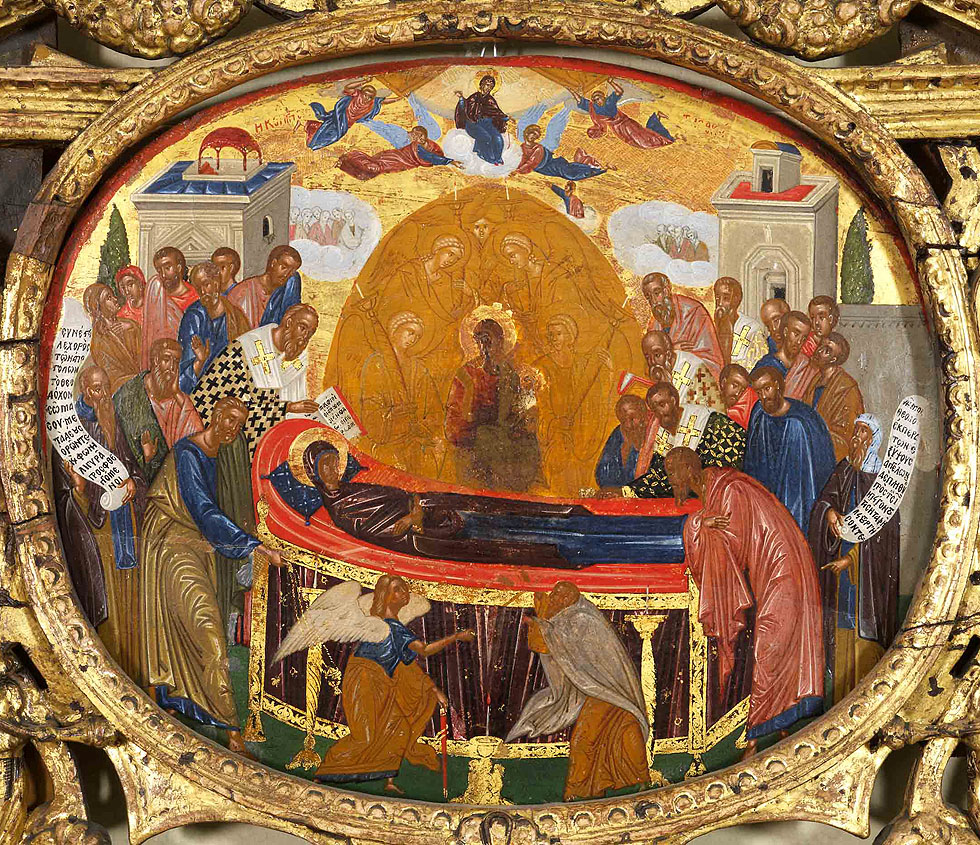
However, though details may differ, a tradition emerged that tells of how the apostles were miraculously brought back to Jerusalem in order to surround the bedside of the Virgin Mary as she lay dying. Upon commending her holy soul to her Son and Savior, she peacefully "fell asleep" in death (the meaning of the word dormition) in the presence of the apostles who stood weeping and grief-stricken by her bedside. With great solemnity they buried her pure body which had itself been the "tabernacle" of the King. The traditional place of her burial is a tomb close to Gethsemane. When the tomb was opened on the third day so that the Apostle Thomas, who arrived late, could venerate the body of the Theotokos, it was found to be empty. The "Mother of Life" was thus "translated to life!"

Archbishop Kallistos Ware summarizes the Church's understanding of this tradition in the following manner:

Without insisting on the literal truth of every element in this account, Orthodox tradition is clear and unwavering in regard to the central point: the Holy Virgin underwent, as did her Son, a physical death, but her body - like His - was afterwards raised from the dead and she was taken up into heaven, in her body as well as in her soul. She has passed beyond death and judgement, and lives wholly in the Age to Come. 

The Resurrection of the Body, which all Christians await, has in her case been anticipated and is already an accomplished fact. That does not mean, however, that she is dissociated from the rest of humanity and placed in a wholly different category: for we all hope to share one day in that same glory of the Resurrection of the Body which she enjoys even now. ( The Festal Menaion, p. 64)

Fr. Thomas Hopko further elaborates on the meaning of this beautiful Feast and how it "relates" to every generation of Christians:

Thus, the feast of the Dormition of the Theotokos is the celebration of the fact that all men are "highly exalted" in the blessedness of the victorious Christ, and that this high exaltation has already been accomplished in Mary the Theotokos. 

The feast of the Dormition is the sign, the guarantee, and the celebration that Mary's fate is the destiny of all those of "low estate" whose souls magnify the Lord, whose spirits rejoice in God the Savior, whose lives are totally dedicated to hearing and keeping the Word of God which is given to men in Mary's child, the Savior and Redeemer of the world.

Dormition, of course, means "falling asleep," the Christian term par excellence for how we approach the mystery of death. And here we further approach the paradox, from a Christian perspective, of death itself - the "last enemy" that causes great anguish and grief; but yet which now serves as a passage to life everlasting, and thus a cause for festal celebration in the death of the Mother of God. For the Virgin Mary truly died, as is the fate of all human beings; and yet "neither the tomb nor death could hold the Theotokos" who has been "translated to life by the One who dwelt in her virginal womb!" Without for a moment losing sight of the reality of death (notice the weeping apostles around the body of the Theotokos on the Dormition icon), from within the Church we can actually celebrate death during this "summer pascha" because of the Resurrection of Christ.

Thus, the Feast of the Dormition clearly raises the issue of death and dying, and what we mean by a “Christian ending to our life.” For the moment, though, here is a challenging paragraph from Fr. Thomas Hopko about some of our own misconceptions – basically our fears – that often find us wandering far from an Orthodox approach to death and dying:

I believe that the issue of death and dying is in need of serious attention in contemporary Orthodoxy, especially in the West, where most members of the Church seem to be “pagan” before people die and “Platonists” afterwards. By this I mean that they beg the Church to keep people alive, healthy, and happy as long as possible, and then demand that the Church assure them after people die that their immortal souls are “in a better place, basking in heavenly bliss” no matter what they may have done in their earthly lives.

To add a bit more to this, here is a passage from Bp. Ilarion Alfeyev, that reinforces the Christian understanding – and hope – that accompanies us at the moment of death:

For the non-believing person, death is a catastrophe and a tragedy, a rupture and a break. For the Christian, though, death is neither a catastrophe nor something evil. Death is a “falling asleep,” a temporary condition of separation from the body until the final unification with it. As Isaac the Syrian emphasizes, the sleep of death is short in comparison with the expectant eternity of a person. — FromOrthodox Christianity, Vol. 2, p. 496.

St. Gregory of Nyssa states this Christian hope with clarity:

By the divine Providence death has been introduced as a dispensation into the nature of man, so that, sin having flowed away at the dissolution of the union of soul and body, man, through the resurrection, might be refashioned, sound, passionless, stainless, and removed from any touch of evil. – Great Catechetical Oration, 35.

This is precisely why we can call the Feast of the Dormition of the Theotokos, “pascha in the summer!” The Virgin Mary and Theotokos died a “deathless death.” Now we have the opportunity to participate in this mystery in the celebration of this event as nothing less than a Feast. The Leave-taking of the Feast is on August 23. That means that we continue to sing and chant the troparion and kontakion of the Feast in our liturgical services until then, in addition to other hymnography of the Feast. I would strongly urge everyone to incorporate these hymns into your daily rule of prayer, including their use when you bless your meals as a family, replacing the Lord's Prayer up until the Leave-taking. If you can't sing these hymns, you can certainly recite them! The troparia and kontakia or the major Feasts are included in many Orthodox Prayer Books, but if you do not have the texts available at home, I am including them here:

Troparion of the Dormition 

In giving birth, you preserved your virginity! 
In falling asleep you did not 
forsake the world, O Theotokos! 
You were translated to life, O Mother of Life, 
and by your prayers you deliver our souls from death! 


Kontakion of the Dormition 

Neither the tomb, nor death, could hold the Theotokos, 
who is constant in prayer and our firm hope in her intercessions. 
For being the Mother of Life, she was translated to life 
by the One who dwelt in her virginal womb!

The decorated tomb of the Theotokos, containing an icon of her sacred body in blessed repose, will be in the center of the church this evening for the Vesperal Liturgy; and then back in its usual place and open for our veneration whenever we enter the church until the Leave-taking.. The great Feasts extend in time, giving us the opportunity of integrating them into our lives in a meaningful way.

Tuesday, August 13, 2024

Coffee with Sister Vassa: HOW DOES THE THEOTOKOS “SAVE” US?

Coffee with Sister Vassa

HOW DOES THE THEOTOKOS “SAVE” US?


“The laws of nature are overcome (Νενίκηνται τῆς φύσεως οἱ ὅροι / Побеждаются естества уставы) in you, O Pure Virgin: for birthgiving remains virginal, and life is united to death; a virgin after childbearing and alive after death, you ever save your inheritance, O Theotokos.” (Canon of Dormition, Ode 9)

On the eve of the great feast (or fast, if we’re on the Older Calendar) of the Dormition of the Theotokos, I’m reflecting on how the above-quoted hymn helps us better understand its final words: “you ever save your inheritance (i.e., all of us), O Theotokos.” 

Let’s first note that we do not confuse the Theotokos with our one-and-only Savior. What we are doing, when we affirm that the Theotokos “saves” us, is professing the indispensable role that she played, as Theo-tokos, in His incarnation, without which we would not have salvation. 

What is “salvation”? It means “a return to wholeness” from previous fragmentation or separation from that wholeness through all the contradictions of our being. Salvation is accomplished by the “Theo(s)”-part of the “Theo-tokos,” by God, but not without her part, the “tokos” or “birth giving” part. Our incarnate Lord integrates and overcomes our contradictions, like life and death, birth giving and virginity, fruitfulness and barrenness, victory and defeat, divinity and humanity, heaven and earth, spirit and body, by becoming one of us, in the flesh, through one of us – the Theotokos. The Mother of God exemplifies, par excellence, the whole Mother-Church that participates in this integration of the contradictions, in this return to wholeness that is “salvation,” in communion with Christ. The above-quoted hymn celebrates the salvific overcoming or integration of the contradictions in and through our “Theo-tokos.” That is to say, through the synergy of God and the human being that is manifested in her unique vocation, which continues to “save” us on a daily basis.

This is why we say, “Most Holy Theotokos, save us!” – and not, “Mary, save us!”because we are professing our faith in the vital, indispensable part of our salvation that is the incarnation. And this is why traditionally we do not depict the Theotokos alone on icons, but always together with the Lord. It’s not just about her, nor just about God. It’s about both her, – a human being just as human as the rest of us, and God, Who invites all of us to participate in the synergy she exemplifies. We’re all invited to be “blessed” by receiving the Word of God (inside us, in our “wombs”) and then to “keep it” by giving it away; by giving birth to it in our world and sharing it in our own context. As Christ said to the woman who cried out from the crowd and blessed His mother (Lk 11:27): “Moreover, blessed are they that hear the word of God and keep it!”

_____

A timely reflection from Sister Vassa as we approach the eve of the Feast of the Dormition. In addition to offering us some very good over-all theological insights into what is a somewhat controversial liturgical text - "Most holy Theotokos, save us!" - when heard in isolation and not placed in a wider context; she also may provide some further insights that we can convey to our Protestant friends (many of whom accept the title Theotokos, or at least in terms of what it reveals about the identity of the Son of God, Jesus Christ).