Showing posts with label Theotokos. Show all posts

Tuesday, August 11, 2026

Dormition fast Meditation -- Afterfeast of the Transfiguration

Source: oca.org

Even though you are asleep, if only Christ has come to know the devotion of your soul, He comes and knocks at her door and says, “Open to Me, My sister.” “Sister” is well put, because the marriage of the Word and the soul is spiritual. For souls do not know covenants of wedlock or the ways of bodily union, but they are like the angels in heaven.

“Open to Me,” but close to strangers. Close to the times, close to the world, do not go out of doors to material things, do not abandon your own light and search for another’s because material light pours out a dark mist, so that the light of true glory is not seen.

“Open yourself to Me,” do not be confined, but expand, and I will fill you. And because, in My passage through the world, I have found very much trouble and vexation and have not readily had a place to rest, do you then open, that the Son of Man may rest His head on you, for He has no rest save on one who is humble and quiet.

—St. Ambrose of Milan, Seven Exegetical Works

Monday, August 10, 2026

Dormition Fast Meditation -- Afterfeast of the Transfiguration

Source: uncutmountainsupply.com

To us Christians, then, who reverence you in our Christian faith, show mercy of your unchanging patronage. We rightly consider your falling asleep as [entry into] life, O Mother of God, and we believe you dwell with us still in the spirit. 

For in times of tribulation you are near, and we find safety in seeking your help; and when it is time to rejoice, you are joy’s sponsor. Whenever we find ourselves completely under your maternal care, we cannot help believing that you live among us. Just as the thirsty person hastens to the spring, every faith-filled heart runs towards you, burning to fill himself with your gracious help. 

And again, just as a breath of air fills a person’s nostrils with life, so the breath of every right-believing Christian bears you on his lips. For we do not draw life from breathing the air to the same degree that we draw safety from the protection of your name; so the text of Scripture is fulfilled in Christ and in you, which says, “You are the breath of our nostrils; we shall live in your protection, and in breathing you” (Lam. 4:20 [LXX]).

—Holy Father Germanus, Archbishop of Constantinople, On the Most Venerable Dormition of the Most Holy Mother of GodHomily I

Monday, August 3, 2026

Dormition Fast Meditation

Source: archangelsbooks.com

Behold the Virgin, the daughter of Adam and Mother of God: because of Adam she commits her body to the earth, but because of her Son she gives her body to the heavenly tabernacle above. Let the holy city be blessed! Let it enjoy blessing upon blessing forever!

Let the angels go before the holy tent as it passes on; let them prepare her tomb carefully! Let the radiance of the Spirit beautify it! Let perfume be made ready, to anoint that wholly spotless, wholly fragrant body. Let a pure wave come and bathe it in blessings from the pure spring of blessing. “Let the earth rejoice” (Ps. 96.11), as her body is laid to rest; let the air leap as her spirit ascends! 

Let the breezes blow, filled with grace as soft as dew! Let all creation celebrate the ascent of the Mother of God!

—St. John of Damascus, A Discourse on the Dormition of Our Lady, the Mother of God, Homily III

Monday, July 27, 2026

Monday Morning Meditation - The Dormition Fast: A Challenge and a Choice

Source: oca.org

On Saturday, August 1, we will begin the relatively short Dormition Fast that always covers the first two weeks of August (1-14), culminating in the Feast of the Dormition on August 15. 


We will celebrate the Feast with Great Vespersl  on Friday evening, August 14; and the Divine Liturgy on Saturday morning, August 15. As has become our tradition, we will place the tomb in the center of the church, decorate it with flowers, venerate the icon of the blessed repose of the Ever-Virgin Mother of God – Miriam of Nazareth - and sing hymns of praise to her “translation” into the Kingdom of Heaven. Not a celebration to be missed! Please mark your calendars and prepare to be present for this beautiful Feast. 

Every fast presents us with a challenge and a choice. In this instance, I would say that our choice is between “convenience” and “commitment.” We can choose convenience, because of the simple fact that to fast is decidedly inconvenient. It takes planning, vigilance, discipline, self-denial, and an over-all concerted effort. It is convenient to allow life to flow on at its usual (summertime) rhythm, which includes searching for that comfort level of least resistance. To break our established patterns of living is always difficult, and it may be something we would only contemplate with reluctance. So, one choice is to do nothing different during this current Dormition Fast, or perhaps only something minimal, as a kind of token recognition of our life in the Church. I am not quite sure, however, what such a choice would yield in terms of further growth in our life “in Christ.” It may rather mean a missed opportunity. 

Yet the choice remains to embrace the Dormition Fast, a choice that is decidedly “counter-cultural” and one that manifests a conscious commitment to an Orthodox Christian “way of life.” Such a commitment signifies that we are looking beyond what is convenient toward what is meaningful. It would be a choice in which we recognize our weaknesses, and our need precisely for the planning, vigilance, discipline, self-denial and over-all concerted effort that distinguishes the seeker of the “mind of Christ” which we have as a gift within the life of the Church. 

That is a difficult choice to make, and one that is perhaps particularly difficult within the life of a family with children who are often resistant to any changes. I still believe, though, that such a difficult choice has its “rewards” and that such a commitment will bear fruit in our families and in our parishes. (If embraced legalistically and judgmentally, however, we will lose our access to the potential fruitfulness of the Fast and only succeed in creating a miserable atmosphere in our homes). It is a choice that is determined to seize a good opportunity as at least a potential tool that leads to spiritual growth.

My opinion and observation is that we combine the “convenient” with our “commitment” within our contemporary social and cultural life to some degree. We often don’t allow the Church to “get in the way” of our plans and goals. And those plans and goals may be hard to avoid in the circumstances and conditions of our present way of life. It is hard to prevail in the never-ending “battle of the calendars.” The surrounding social and cultural milieu no longer supports our commitment to Christ and the Church. In fact, it is usually quite indifferent and it may even be hostile toward such a commitment. 

Though we may hesitate to admit it, we find it very challenging not to conform to the world around us. But it is never impossible to choose our commitment to our Orthodox Christian way of life over what is merely convenient – or simply desired. That may just be one of those “daily crosses” that the Lord spoke of – though it may be a stretch to call that a “cross.” This also entails choices, and we have to assess these choices with honesty as we look at all the factors that make up our lives. In short, it is very difficult – but profoundly rewarding - to practice our Orthodox Christian Faith today!

I remain confident, however, that the heart of a sincere Orthodox Christian desires to choose the hard path of commitment over the easy (and rather boring?) path of convenience. We now have the God-given opportunity to escape the summer doldrums that drain our spiritual energy. With prayer, almsgiving and fasting, we can renew our tired bodies and souls. We can lift up our “drooping hands” in an attitude of prayer and thanksgiving.

The Dormition of the Theotokos has often been called “pascha in the summer.” It celebrates the victory of life over death; or of death as a translation into the Kingdom of Heaven. The Dormition Fast is our spiritually-vigilant preparation leading up to that glorious celebration. 

“Behold, now is the acceptable time; behold now is the day of salvation!”(II COR. 6:2)

_____

Addendum. From St. Vladimir's Seminary:

Dear Fr. Steven,

Glory to Jesus Christ, Glory forever!

Thank you for signing up to receive Meditations on the Dormition of Our Most Holy Lady, the Mother of God.

Every day beginning August 1 through August 15 you will get an email containing a meditation and daily scripture passages related to the Dormition Fast. 

We pray these meditations will bless and prepare you for the feast of The Dormition of our Most Holy Lady, the Mother of God. 

I will share these with the entire parish starting on August 1.

Thursday, December 18, 2025

On the Veneration of the Theotokos -- Learning to Love the Mother of God

Source: legacyicons.com

As a follow-up to our zoom class on Monday evening, "The Orthodox Veneration of the Theotokos;" I asked two our parishioner who have been Orthodox long enough to absorb the Church's veneration of the Virgin Mary for at least a few years now, to respond with a reflection of their own about how they now perceive, acknowledge and venerate her. Here is the first one, written by Kevin Rains:

Learning to Love the Mother of God

I did not come to love Mary, the Theotokos (God-bearer) all at once.

As a Protestant, I was taught—sometimes subtly, sometimes directly—to keep my distance from Mary. She was honored as faithful and obedient, but always at arm’s length. The concern was understandable: guard the uniqueness of Christ, avoid anything that smelled like excess, keep devotion tethered tightly to Scripture. When I first encountered Orthodox Christianity, I brought that posture with me. I listened carefully. I watched for imbalance. I told myself I would follow the logic of the faith, but I would do so cautiously.

Mary was the slowest piece to fall into place.

At first, I encountered her primarily through liturgy and hymnography. She was everywhere—named, invoked, praised. That made me uneasy. Yet what surprised me was not what the Church said about her, but what it did not say. Christ was never displaced. The Gospel was never softened. Instead, Mary seemed to stand consistently in one place: pointing beyond herself, receiving rather than grasping, magnifying rather than competing.

The first real turning point for me came through a passage I thought I already understood.

In the Gospels, Jesus is told that His mother and brothers are standing outside, seeking Him. His response is startling:

“Who is My mother, or My brothers?”

And looking about at those who sat around Him, He said,

“Here are My mother and My brothers!

For whoever does the will of God is My brother and My sister and mother.”

(Mark 3:33–35; see also Matthew 12:46–50; Luke 8:19–21)

For most of my Protestant life, I heard this as a corrective - almost a rebuke. Jesus, I assumed, was relativizing Mary’s importance, moving the focus away from biology and toward spiritual obedience. And that is partly true. But what I had never considered is that this saying does not diminish Mary - it defines her.

Jesus is not saying, “Mary does not matter.”

He is saying, “This is why she matters.”

Of course, we honor Mary as the Theotokos because she bore the Word of God in her womb. Yet, she is equally honored 
because she embodies the very thing Jesus describes: the one who hears the word of God and does it. In Luke’s Gospel, this connection is made even more explicit. After the same episode, Jesus says:

“My mother and My brothers are those who hear the word of God and do it.”

(Luke 8:21)

That verse became impossible for me to read in isolation from the Annunciation.

When the angel Gabriel announces God’s invitation to Mary, her response is neither passive nor coerced:

“Behold, the handmaid of the Lord;

let it be to me according to your word.”

(Luke 1:38)

Here is the fulfillment of Christ’s later teaching—spoken decades before He ever preached it. Mary hears the word of God, and she submits to it freely. She does not fully understand the cost. She does not control the outcome. But she consents. Voluntarily. Faithfully.

In that moment, Mary becomes both the Theotokos ("God-bearer") and the first disciple.

This realization changed everything for me. The question was no longer whether honoring Mary distracted from Christ. The question became whether my resistance to Mary was actually blinding me to something essential about discipleship itself. Mary is not an exception to Jesus’ teaching; she is its first and fullest example.

And this is where affection began to grow.

Orthodox devotion to the Theotokos is not about elevating Mary beyond humanity, but about showing what humanity looks like when it fully receives God’s grace. She does not seize authority. She receives a calling. She does not speak often in the Gospels, but when she does, her words are saturated with Scripture and trust (Luke 1:46–55). She stands at the foot of the Cross (John 19:25), not as a theological concept, but as a mother who remains faithful when everything appears lost.

As a Protestant, I was formed to think clearly, argue carefully, and guard doctrine faithfully. Orthodoxy did not take those things away. But devotion to the Theotokos revealed something I had not been trained to see as clearly: that obedience, humility, and love are not secondary virtues—they are the soil in which Christ is received.

I did not lose Christ by learning to love His mother.

I encountered Him more fully—incarnate, vulnerable, and real.

I came to the Theotokos cautiously.

I stay because Scripture, read patiently and lived deeply, led me there.

Kevin Rains

Tuesday, March 25, 2025

The Announcement of the Incarnation

Source: uncutmountainsupply.com

 "Behold the handmaiden of the Lord, be it unto me according to your will." (Lk. 1:38)


Today, March 25, is the Feast of the Annunciation to the Most Holy Theotokos. This great feast always falls during Great Lent, and when it falls on a weekday, it is the only instance of having the full eucharistic Liturgy served for its commemoration. Clearly a sign of the feast’s significance. Thus, the Annunciation is something of a festal interlude that punctuates the eucharistic austerity of the lenten season. Yet, because it does occur during Great Lent, this magnificent feast appears and disappears rather abruptly. It seems as if we have just changed the lenten colors in church to the blue characteristic of feasts dedicated to the Theotokos, when they are immediately changed back again! This is so because the Leavetaking of the Annunciation is on March 26. If we are not alert, it can pass swiftly by undetected by our “spiritual radar” which needs to be operative on a daily basis.


This Feast has its roots in the biblical passage in St. Luke’s Gospel, wherein the evangelist narrates that incredibly refined dialogue between the angel Gabriel and the Virgin Mary (LK. 1:26-38). The angel Gabriel will “announce” the joyful news of the impending birth of the Messiah, and hence our English name of “Annunciation” for the Feast. However, the Greek title of Evangelismos is even richer in that it captures the truth that the Gospel – evangelion – is being “announced” in the encounter between God’s messenger and the young maiden destined to be the Mother of God. Her “overshadowing” by the Holy Spirit is “Good News” for her and for the entire world! Even though the Feast of the Lord’s Nativity in the flesh dominates our ecclesial and cultural consciousness, it is this Feast of the Annunciation that reveals the Incarnation, or the “becoming flesh” of the eternal Word of God. It is the Word’s conception in the womb of the Virgin Mary that is the “moment” of the Word’s enfleshment. Hence, the Church’s insistence that a new human being begins to exist at the moment of conception. The Word made flesh – our Lord Jesus Christ – will be born nine months later on December 25 according to our liturgical calendar; but again, His very conception is the beginning of His human life as God-made-man. The troparion of the Feast captures this well:

Today is the beginning of our salvation; the revelation of the eternal Mystery! 
The Son of God becomes the Son of the Virgin as Gabriel announces the coming of Grace.
Together with him let us cry to the Theotokos: Rejoice, O Full of Grace, the Lord is with you.

Was the Virgin Mary randomly chosen for this awesome role? Was she compelled to fulfill the will of God regardless of her spiritual relationship with God? Was she a mere instrument overwhelmed or even “used” by God for the sake of God’s eternal purpose? That the Virgin Mary was “hailed” as one “highly favored” or “full of grace” (Gk. kecharitōmenē) when the angel Gabriel first descended to her, points us well beyond any such utilitarian role for her. On the contrary, the Annunciation to the Virgin Mary is understood and presented by the Church as the supreme example of synergy in the Holy Scriptures. The word synergy denotes the harmonious combination and balance between divine grace and human freedom that can occur between God and human beings. God does not compel, but seeks our free cooperation to be a “co-worker” with God in the process of salvation and deification. In this way, God respects our human self-determination, or what we refer to as our freedom or “free will.” 

It is the Virgin Mary’s free assent to accept the unique vocation that was chosen for her from all eternity that allows her to become the Theotokos, or God-bearer. This is, of course, found in her response to the angel Gabriel’s announcement, and following her own perplexity:  “Behold, I am the handmaid of the Lord; let it be to me according to your word.” This teaching on synergy finds its classical expression in a justifiably famous passage from St. Nicholas Cabasilas’ Homily on the Annunciation. The passage itself is often cited as an excellent and eloquent expression of the Orthodox understanding of synergy: 

The incarnation of the Word was not only the work of the Father, Son and Spirit – the first consenting, the second descending, and third overshadowing – but it was also the work of the will and faith of the Virgin. Without the three divine persons this design could not have been set in motion; but likewise the plan could not have been carried into effect without the consent and faith of the all-pure Virgin. Only after teaching and persuading her does God make her his Mother and receive from her the flesh which she consciously wills to offer him. Just as he was conceived by his own free choice, so in the same way she became his Mother voluntarily and with her free consent.

We praise the Virgin Mary as representing our longing for God and for fulfilling her destiny so that we may receive the gift of salvation from our Lord who “came down from heaven and was incarnate of the Holy Spirit and the Virgin Mary and became man” (Nicene Creed):

Hail, thou who art full of grace: the Lord is with thee.

Hail, O pure Virgin;

Hail, O Bride unwedded

Hail, Mother of life: blessed is the fruit of thy womb.


(Dogmatikon, Vespers of the Annunciation)

Monday, February 3, 2025

Coffee With Sister Vassa: “SEEING” CHRIST, THROUGH THE THEOTOKOS


“SEEING” CHRIST, THROUGH THE THEOTOKOS


“Let us hasten to the Theotokos, we who want to see her Son, brought unto Simeon…./ К Богоро́дице притеце́м, хотя́щии Сы́на Ея́ ви́дети, к Симео́ну носи́ма…” (Ikos, Meeting of the Lord)

Yesterday, many celebrated the great feast of the Meeting of the Lord, known in Western traditions as The Presentation. The above-quoted hymn, known as the “Ikos” (that immediately follows the Kontakion of the feast) reminds us that it is through the Theotokos that both Simeon and the rest of us are given to “see” Christ, – that is, when we “want” to see Him. The desire to see Christ is something we also heard about yesterday, if in our church we had the Gospel-reading about Zacchaeus.

The Lord is “brought unto Simeon,” and brought into Zacchaeus’s world and our world, in the flesh, through the flesh of the teenaged Virgin from Nazareth. It is she who carries Him in her arms into the temple, in obedience to the Law and in obedience to the Spirit, by Whom Simeon came to the temple at this same time, as we read in the Gospel: “So he came by the Spirit into the temple.” (Lk 2:27) Thanks to her, Simeon in his old age is finally able to “see” what he has longed to see all his life: the “salvation” embodied both in Christ and the Virgin Mother, as he professes: “For my eyes have seen Your salvation…”

The Mother of God is seen traditionally as a symbol of the Church Mother. So, the priestly thing she does here, of bringing the Body and Blood of Christ to those “who want to see her Son,” is a thing that the Church does, for and through all of us, the merely-human beings that participate in the Church’s“royal priesthood.” Both the feast of the Meeting of the Lord and the reading about Zacchaeus remind me that our desire and capacity for “seeing God,”called “Theoptia” in Greek, is essential for us to develop and nourish, by taking care of our heart, that it is cleared of grace-blocking and vision-impairing garbage like resentments, self-centered fears, etc., so we can also share this vision with others, as Church, and as did and does the Mother of our Lord.“Blessed are the pure in heart,” our Lord tells us, “for they shall see God” in every circumstance. “Let us hasten to the Theotokos,” dear friends, “we who want to see her Son,” because she and other God-bearers in our midst, both visible and invisible, are able and willing to do that, in the ever-unfolding Mystery of the life of the Church.

Tuesday, December 17, 2024

MARY - Woman and Mother

Image source: legacyicons.com

Dear Parish Faithful,

Here are a couple of insightful paragraphs on the role of the Virgin Mary in the divine oikonomia. These passages also offer good insight into the ever-perplexing genealogy found in St. Matthew's Gospel, and the undeniably major role assumed by women in that genealogy:

"Mary is presented as the final and perfect instrument in God's providential history. She brings to fruition a long history of courageous women and mothers, as she gives birth to the Messianic son of David, son of Abraham (Matt. 1:1). Matthew indicates that Israel's sacred history has been marked, from its very beginning, by women open to God's action in their lives, cost them what it may. The presence of the feminine through the religious history of Israel, incarnated in the women mentioned explicitly by Matthew, and culminated in Mary of Nazareth, shows that, despite all the judgments of society, religion and culture, they were the ones who were open to the initiative of God working in them. Thus, one of them became the mother of the Messiah."

"The earliest Church immediately saw Mary as a woman and a mother. These themes are repeated in Matthew, but now we see Mary understood and presented as the perfection of all the women who have played a decisive role in the gradual unfolding of God's salvation history to become the mother of Jesus Christ. Tamar, Rahab, Ruth and Bathsheba are not only women of great significance in critical moments of God's unfolding plan for his people. There is more to their role: they are included in the genealogy, written in a way which indicated that it is God-directed, because of their husbands and the sons they bore to them. They are both women and mothers."


MARY - Woman and Mother, by Francis J. Moloney


Wednesday, December 4, 2024

Coffee With Sister Vassa: "Innocent" Suffering


“INNOCENT” SUFFERING 


“I will receive the cup of salvation and call on the name of the Lord.”(Ps. 115:4)

This verse is relevant to both feasts celebrated this Wednesday: the Great Martyr Barbara (NC) and the Entry (or “Leading In” in Slavonic,Vvedenie) of the Theotokos into the Temple (OC). The verse is chanted on feasts of the Theotokos as the Communion Verse, because it connotes the “cup” of suffering, of which the Most Holy Virgin was to drink throughout her unique vocation. Note that the word “cup” in the Bible often means suffering, as in, “Father, if it is Your will, take this cup away from Me…” (Lk 22:42).

I’m thinking of the suffering that was to be endured by the three-year-old Mary, and of the young Barbara, who, together with Juliana (who was inspired by Barbara’s fearlessness and ended up being martyred with her) “received” the “cup of salvation.” In Barbara’s case, this included the heartbreak of her own father, Dioscorus, having her arrested and later beheading her with his own hands. Before their execution, both Barbara and Juliana were led naked through their city, amidst the derision and jeers of the crowds. I’m thinking also how the young Mary was led, not only into the Temple at age three, being separated from her parents, - but a decade or so later, when she was very-pregnant and both her parents had died, how she was led to Bethlehem, seated on a donkey. This reminds me of our Lord, seated on a donkey, entering Jerusalem, where He was to die His death-trampling death. 

How can we process the “innocent suffering” described above? Let’s first re-think the word “innocent,” which means “harmless,” from the Latin in + nocere, meaning “not to hurt/harm.” And let’s establish that the self-offering of the Theotokos, of Barbara and Juliana, and of their Lord, was by no means “harmless.” Their overcoming of fear, when they were called to “receive the cup of salvation” and testify to Truth, was a liberating sign that dealt a heavy blow to merely-human fear, and to those who terrorized entire peoples through it.“Behold, this Child is destined for the fall and rising of many in Israel, and for a sign which will be spoken against…,” as Simeon said to Mary, when she brought Him into the Temple.

Today we celebrate the mystifying self-offering of the three-year-old Theotokos, and of Barbara and Juliana, in gratitude for their testimony. They testified to the Great Fact that there is more to life and to death than what self-preserving fears would dictate to us. Thank You, Lord, for the Holy Witnesses in our midst. By their prayers, Savior, save us!

Monday, September 9, 2024

The Synaxis of Sts. Joachim and Anna


Dear Parish Faithful & Friends in Christ,

"Rejoice, O divinely chosen pair who gave birth to her who would become the Mother of One of the Trinity!"   

(Akathist to the Righteous Joachim and Anna)

On the day following the Feast of the Nativity of the Theotokos – today, September 9 – we commemorate the “ancestors of God,” Joachim and Anna, the father and mother of the Virgin Mary according to the Tradition of the Church. This is a consistent pattern within our festal and liturgical commemorations: On the day after a particular feast, we commemorate the persons who are an integral part of that feast day’s events. For example, the day after Theophany we commemorate St. John the Baptist; and on the day after Nativity, we commemorate the Theotokos. Therefore, because of the (obviously!) essential role of Joachim and Anna in the current Feast of the Virgin Mary’s Nativity, September 9 is the “Synaxis of Joachim and Anna” and we thus bring them to mind in an effort to discern and meditate upon their important place in this festal commemoration.

The source of their respective roles is the Protoevangelion of James, a mid 2nd c. document. As Archbishop Ware has written:

The Orthodox Church does not place the Protoevangelion of James on the same level as Holy Scripture: it is possible, then, to accept the spiritual truth which underlies this narrative, without necessarily attributing a literal and historical exactness to every detail. 

One of those “spiritual truths” alluded to by Archbishop Ware is the account of both Joachim and Anna continuing to pray with faith and trust in God’s providence even though they were greatly discouraged over the “barrenness” of Anna. This is no longer our perception today, for not being able to have a child is hardly a sign of "barrenness!" And it also implies that this is a "woman's" problem, thus disengaging the man's role in the process of conception. Yet, it is true that a lack of children in ancient Israel could easily be taken for a sign of God’s displeasure, thus hinting at hidden sins that deserve rebuke. Though disheartened, they continued to place their trust in God, refusing to turn away from God though thoroughly tested as to their patience. Perseverance in prayer in the face of discouragement is a real spiritual feat that reveals genuine faith. The conception and then birth of the Virgin Mary reveals the joyous outcome of their faith and trust in God. Perhaps this is why we commemorate Joachim and Anna as the “ancestors of God” at the end of every Dismissal in our major liturgical services, including the Divine Liturgy: We seek their prayers as icons of an everyday faith that is expressed as fidelity, faith and trust in God’s Law and providential care.

Joachim and Anna could also be witnesses to a genuine conjugal love that manifests itself in the conception and birth of a new child. Their union is an image of a “chaste” sexual love that is devoid of lust and self-seeking pleasure. The strong ascetical emphases of many of our celibate saints may serve to undermine or obscure the blessings of conjugal love as envisaged in the Sacrament of Marriage. In fact, through its canonical legislation going back to early centuries, the Church has struggled against a distorted asceticism that denigrates sexual love even within the bonds of marriage as a concession to uncontrollable passions. The Church is not “anti-sex.” But the Church always challenges us to discern the qualitative distinction between love and lust. The icon of the embrace of Joachim and Anna outside the gates of their home as they both rush to embrace each other following the exciting news that they would indeed be given a child, is the image of this purified conjugal love that will result in the conception of Mary, their child conceived as all other children are conceived.

The Feast of the Nativity of Our Most Holy Lady the Theotokos has four days of Afterfeast, thus ending with the Leavetaking on September 12. That allows us to then prepare for the Feast of the Elevation of the Cross on September 14!

Friday, August 16, 2024

Coffee with Sister Vassa: THE MOTHER OF LIFE

COFFEE WITH SISTER VASSA

THE MOTHER OF LIFE


“Neither the tomb, nor death could hold the Theotokos, / Who is constant in prayer and our firm hope in her intercessions. / For being the Mother of Life, / She was translated to life by the One who dwelt in her ever-virginal womb.” (Kontakion-hymn of the Dormition of the Theotokos)

Just as St. Peter said about the Source of Life, our risen Lord, that it was impossible that He should be “held” by death (Acts 2: 24), we sing in the above-quoted hymn that death “could not hold” the Mother of Life. As one with a unique role in Salvation History, the Mother of God also has a unique, personal “salvation history”: She experienced Pentecost before anyone else, at the Annunciation (cf. Lk 1: 35, “The Holy Spirit will come upon you…”), and she received the grace of bodily resurrection before the completion of time, being“translated to life” shortly after her repose “by the One who dwelt in her ever-virginal womb.” 

In the one “Full of Grace,” the Mother of God, the usual “laws of nature are vanquished” (νενίκηνται τῆς φύσεως οἱ ὅροι / побеждаются естества уставы), as we chant in Ode 9 of the Canon of Dormition. Because grace turns things around, making the seemingly-impossible possible; making us strong in our weaknesses; and even making the “tomb” of the virginal womb a source of life.

Today, as those of us on the New Calendar celebrate the Dormition of the Theotokos, and those of us on the Older Calendar enter the second day of Dormition Fast, I say thank you to the Blessed Among Women. Thank you for not abandoning us at your Dormition, at which even a death, your death, is a celebration of Life. Thank you, our one-and-only Mother of Life, for showing us this radical, transfigurative power of God’s grace, which springs life even from our potentially death-bringing places. Help me to turn things around today, as I choose to rely not on my own “power,” but on the transfigurative power of God, in Whom all things are possible. “By your prayers you deliver our souls from death.” (Troparion-hymn of Dormition)

Thursday, August 15, 2024

'Beyond Death and Judgment' - The Dormition of the Theotokos


Dear Parish Faithful & Friends in Christ,
 

The Feast of the Dormition of the Theotokos has come to be experienced as something of a "summer pascha," and as such has steadily become an integral event of our parish life. And this is "meet and right."

American Christianity has been shaped by the Protestant ethos, and that basically means that there is no real place for the veneration of the Mother of God. This was primarily based upon a reaction against the perceived excesses of the medieval West's Marian piety by the early Protestant reformers. In a short time, this reaction became a thorough rejection - at times quite vehement - in many Protestant circles. So the Virgin Mary pretty much disappeared from Protestant worship and piety. Perhaps the classic example within Church history of "throwing out the baby with the bath water."

Orthodox Christians cannot succumb to any such truncated form of the Church's living Tradition. (However, there have been clear signs recently of a "recovery" of the role of the Virgin Mary in some Evangelical circles). One of my beloved professors from seminary always used to say that a sign of a spiritually strong parish is that parish's devotion to the Mother of God. For she is the personal image of the Church - warm, embracing, nurturing, protecting.

Since the Dormition has no biblical source, this feast slowly developed over the course of the first five centuries of the Church's history on the basis of a wide variety of sources - primarily narratives, rhetorical homilies and theological poetry/hymnography. (Much of this material now exists in English translation). There is no one authoritative text or document.

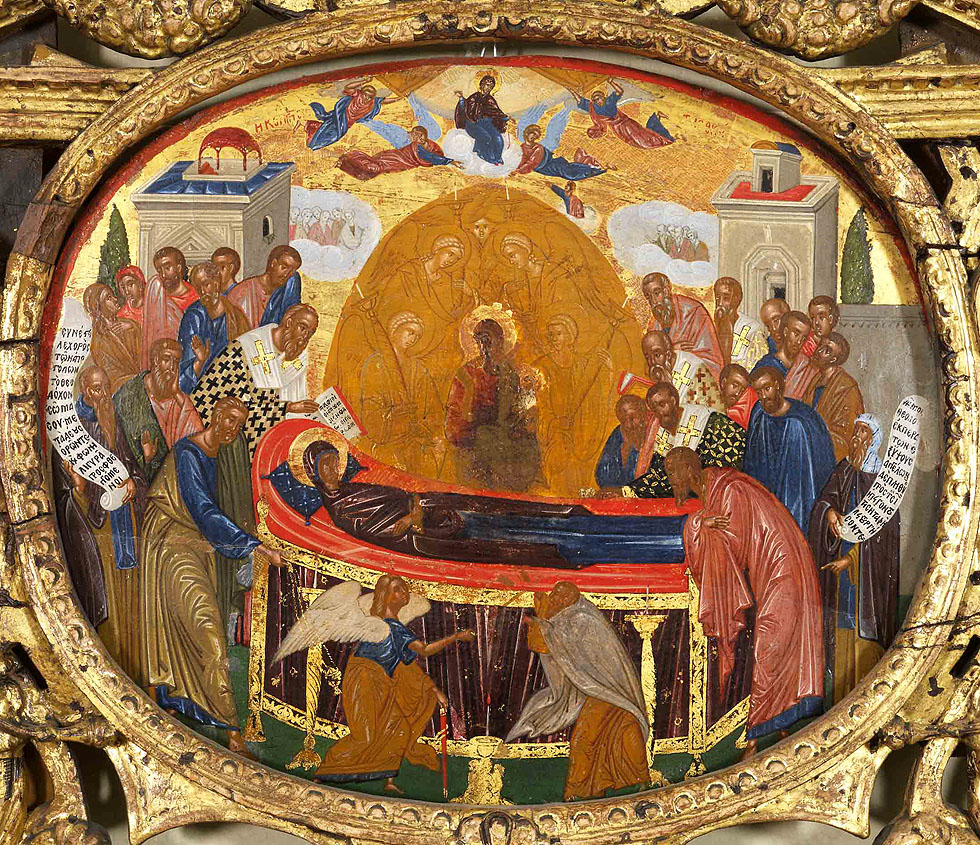
However, though details may differ, a tradition emerged that tells of how the apostles were miraculously brought back to Jerusalem in order to surround the bedside of the Virgin Mary as she lay dying. Upon commending her holy soul to her Son and Savior, she peacefully "fell asleep" in death (the meaning of the word dormition) in the presence of the apostles who stood weeping and grief-stricken by her bedside. With great solemnity they buried her pure body which had itself been the "tabernacle" of the King. The traditional place of her burial is a tomb close to Gethsemane. When the tomb was opened on the third day so that the Apostle Thomas, who arrived late, could venerate the body of the Theotokos, it was found to be empty. The "Mother of Life" was thus "translated to life!"

Archbishop Kallistos Ware summarizes the Church's understanding of this tradition in the following manner:

Without insisting on the literal truth of every element in this account, Orthodox tradition is clear and unwavering in regard to the central point: the Holy Virgin underwent, as did her Son, a physical death, but her body - like His - was afterwards raised from the dead and she was taken up into heaven, in her body as well as in her soul. She has passed beyond death and judgement, and lives wholly in the Age to Come. 

The Resurrection of the Body, which all Christians await, has in her case been anticipated and is already an accomplished fact. That does not mean, however, that she is dissociated from the rest of humanity and placed in a wholly different category: for we all hope to share one day in that same glory of the Resurrection of the Body which she enjoys even now. ( The Festal Menaion, p. 64)

Fr. Thomas Hopko further elaborates on the meaning of this beautiful Feast and how it "relates" to every generation of Christians:

Thus, the feast of the Dormition of the Theotokos is the celebration of the fact that all men are "highly exalted" in the blessedness of the victorious Christ, and that this high exaltation has already been accomplished in Mary the Theotokos. 

The feast of the Dormition is the sign, the guarantee, and the celebration that Mary's fate is the destiny of all those of "low estate" whose souls magnify the Lord, whose spirits rejoice in God the Savior, whose lives are totally dedicated to hearing and keeping the Word of God which is given to men in Mary's child, the Savior and Redeemer of the world.

Dormition, of course, means "falling asleep," the Christian term par excellence for how we approach the mystery of death. And here we further approach the paradox, from a Christian perspective, of death itself - the "last enemy" that causes great anguish and grief; but yet which now serves as a passage to life everlasting, and thus a cause for festal celebration in the death of the Mother of God. For the Virgin Mary truly died, as is the fate of all human beings; and yet "neither the tomb nor death could hold the Theotokos" who has been "translated to life by the One who dwelt in her virginal womb!" Without for a moment losing sight of the reality of death (notice the weeping apostles around the body of the Theotokos on the Dormition icon), from within the Church we can actually celebrate death during this "summer pascha" because of the Resurrection of Christ.

Thus, the Feast of the Dormition clearly raises the issue of death and dying, and what we mean by a “Christian ending to our life.” For the moment, though, here is a challenging paragraph from Fr. Thomas Hopko about some of our own misconceptions – basically our fears – that often find us wandering far from an Orthodox approach to death and dying:

I believe that the issue of death and dying is in need of serious attention in contemporary Orthodoxy, especially in the West, where most members of the Church seem to be “pagan” before people die and “Platonists” afterwards. By this I mean that they beg the Church to keep people alive, healthy, and happy as long as possible, and then demand that the Church assure them after people die that their immortal souls are “in a better place, basking in heavenly bliss” no matter what they may have done in their earthly lives.

To add a bit more to this, here is a passage from Bp. Ilarion Alfeyev, that reinforces the Christian understanding – and hope – that accompanies us at the moment of death:

For the non-believing person, death is a catastrophe and a tragedy, a rupture and a break. For the Christian, though, death is neither a catastrophe nor something evil. Death is a “falling asleep,” a temporary condition of separation from the body until the final unification with it. As Isaac the Syrian emphasizes, the sleep of death is short in comparison with the expectant eternity of a person. — FromOrthodox Christianity, Vol. 2, p. 496.

St. Gregory of Nyssa states this Christian hope with clarity:

By the divine Providence death has been introduced as a dispensation into the nature of man, so that, sin having flowed away at the dissolution of the union of soul and body, man, through the resurrection, might be refashioned, sound, passionless, stainless, and removed from any touch of evil. – Great Catechetical Oration, 35.

This is precisely why we can call the Feast of the Dormition of the Theotokos, “pascha in the summer!” The Virgin Mary and Theotokos died a “deathless death.” Now we have the opportunity to participate in this mystery in the celebration of this event as nothing less than a Feast. The Leave-taking of the Feast is on August 23. That means that we continue to sing and chant the troparion and kontakion of the Feast in our liturgical services until then, in addition to other hymnography of the Feast. I would strongly urge everyone to incorporate these hymns into your daily rule of prayer, including their use when you bless your meals as a family, replacing the Lord's Prayer up until the Leave-taking. If you can't sing these hymns, you can certainly recite them! The troparia and kontakia or the major Feasts are included in many Orthodox Prayer Books, but if you do not have the texts available at home, I am including them here:

Troparion of the Dormition 

In giving birth, you preserved your virginity! 
In falling asleep you did not 
forsake the world, O Theotokos! 
You were translated to life, O Mother of Life, 
and by your prayers you deliver our souls from death! 


Kontakion of the Dormition 

Neither the tomb, nor death, could hold the Theotokos, 
who is constant in prayer and our firm hope in her intercessions. 
For being the Mother of Life, she was translated to life 
by the One who dwelt in her virginal womb!

The decorated tomb of the Theotokos, containing an icon of her sacred body in blessed repose, will be in the center of the church this evening for the Vesperal Liturgy; and then back in its usual place and open for our veneration whenever we enter the church until the Leave-taking.. The great Feasts extend in time, giving us the opportunity of integrating them into our lives in a meaningful way.

Tuesday, August 13, 2024

Coffee with Sister Vassa: HOW DOES THE THEOTOKOS “SAVE” US?

Coffee with Sister Vassa

HOW DOES THE THEOTOKOS “SAVE” US?


“The laws of nature are overcome (Νενίκηνται τῆς φύσεως οἱ ὅροι / Побеждаются естества уставы) in you, O Pure Virgin: for birthgiving remains virginal, and life is united to death; a virgin after childbearing and alive after death, you ever save your inheritance, O Theotokos.” (Canon of Dormition, Ode 9)

On the eve of the great feast (or fast, if we’re on the Older Calendar) of the Dormition of the Theotokos, I’m reflecting on how the above-quoted hymn helps us better understand its final words: “you ever save your inheritance (i.e., all of us), O Theotokos.” 

Let’s first note that we do not confuse the Theotokos with our one-and-only Savior. What we are doing, when we affirm that the Theotokos “saves” us, is professing the indispensable role that she played, as Theo-tokos, in His incarnation, without which we would not have salvation. 

What is “salvation”? It means “a return to wholeness” from previous fragmentation or separation from that wholeness through all the contradictions of our being. Salvation is accomplished by the “Theo(s)”-part of the “Theo-tokos,” by God, but not without her part, the “tokos” or “birth giving” part. Our incarnate Lord integrates and overcomes our contradictions, like life and death, birth giving and virginity, fruitfulness and barrenness, victory and defeat, divinity and humanity, heaven and earth, spirit and body, by becoming one of us, in the flesh, through one of us – the Theotokos. The Mother of God exemplifies, par excellence, the whole Mother-Church that participates in this integration of the contradictions, in this return to wholeness that is “salvation,” in communion with Christ. The above-quoted hymn celebrates the salvific overcoming or integration of the contradictions in and through our “Theo-tokos.” That is to say, through the synergy of God and the human being that is manifested in her unique vocation, which continues to “save” us on a daily basis.

This is why we say, “Most Holy Theotokos, save us!” – and not, “Mary, save us!”because we are professing our faith in the vital, indispensable part of our salvation that is the incarnation. And this is why traditionally we do not depict the Theotokos alone on icons, but always together with the Lord. It’s not just about her, nor just about God. It’s about both her, – a human being just as human as the rest of us, and God, Who invites all of us to participate in the synergy she exemplifies. We’re all invited to be “blessed” by receiving the Word of God (inside us, in our “wombs”) and then to “keep it” by giving it away; by giving birth to it in our world and sharing it in our own context. As Christ said to the woman who cried out from the crowd and blessed His mother (Lk 11:27): “Moreover, blessed are they that hear the word of God and keep it!”

_____

A timely reflection from Sister Vassa as we approach the eve of the Feast of the Dormition. In addition to offering us some very good over-all theological insights into what is a somewhat controversial liturgical text - "Most holy Theotokos, save us!" - when heard in isolation and not placed in a wider context; she also may provide some further insights that we can convey to our Protestant friends (many of whom accept the title Theotokos, or at least in terms of what it reveals about the identity of the Son of God, Jesus Christ). 


Thursday, August 17, 2023

Rejoicing in the "Deathless Death"


Dear Parish Faithful & Friends in Christ,

"Words cannot attain to what is beyond speech, just as eyes cannot stare at the sun. But though it is impossible for us to tell of things surpassing words, we can, by the love of those we extol, sing their praises, and we may use words to pay our debt, and express our longing for the Mother of God in hymns as best we can, without in any way touching the intangible." ~ St. Gregory Palamas, Homily On the Dormition.

As I like to occasionally point out, the Twelve Major Feast Days of the Church year do not simply "come and go" in a twenty-four hour period. In fact, if you glance at a church calendar, you may come across the following notations when encountering a major Feast: "forefeast," "afterfeast," and "leavetaking (of the Feast)." This is well-illustrated by the Feast we are now continuing to celebrate - The Dormition of the Theotokos. In the Festal Menaion that most of our parishes use (the one translated by Mother Maria and Archimandrite Kallistos Ware), we read the following notation concerning this particular Feast:

The Dormition of the Theotokos (15 August).
One day of forefeast (14 August).
Eight days of afterfeast (16-23 August).

This is the "longest" of the Feasts dedicated to the Mother of God in terms of duration and, as the dates fall this year, the "Leavetaking" will occur next Wednesday, August 23. And that means that we will continue to celebrate this Feast at this coming Sunday's Liturgy. Therefore, we will again have the joy of expressing "our longing for the Mother of God in hymns as best we can," as St. Gregory Palamas has so eloquently stated. This has been the case throughout this past week, as the Church allows us to further contemplate and experience the mystery of the falling asleep of the Theotokos and its bearing on our lives. There is nothing more "theo-logical" than connecting the life and death of the Mother of God with that of her Son and Savior, our Lord Jesus Christ. The Lord did not pass through His mother, but was truly born of her, "ineffably" and "without seed" as we sing and chant when praising this great mystery of the Incarnation. If the Mother of God held her Son in her arms when He was born; then when she is "born" into the new life of the Kingdom of God, her Son will bear her soul in His arms:

She who is higher than the heavens and more glorious than the cherubim, she who is held in greater honor than all creation, she who by reason of her surpassing purity became the receiver of the everlasting Essence, today commends her most pure soul into the hands of her Son. With her all things are filled with joy and she bestows great mercy upon us. 

Sing, O ye people, sing ye the praises of the Mother of our God:for today she delivers her soul, full of light, into the immaculate hands of Him who was made incarnate of her without seed... (Lity at Great Vespers)

But since the Mother of God is not the "great exception" but rather the "great example," she embodies our greatest longing and hope for human beings created "in the image and likeness of God:" To truly "fall asleep" in the Lord surrounded by our loved ones, as she was surrounded by the apostles and friends, according to Tradition; to offer our soul/life to the Risen and ever-present Lord as a final eucharistic gift in the humble assurance that He will receive it and "carry" it into His everlasting Kingdom; and that we are buried to the accompaniment of "psalms, hymns and spiritual songs" that express our belief that death has been overcome in the death and resurrection of Christ. Although not an "official dogma" of the Church, the belief exists that the Mother of God was bodily "translated" to heaven, since the Lord did not allow the most pure temple of the Word to experience corruption:

The Lord and God of all gave thee as thy portion the things that are abovenature. For just as He kept thee virgin in thy childbirth so did He preserve thy body incorrupt in the tomb; and He glorified thee by a divine Translation, showing thee honour as a Son to His Mother. (Matins, First Canon, Canticle Six)

As Archbishop Kallistos says in his explanation of the theological meaning of this Feast:

... Orthodox Tradition is clear and unwavering in regard to the central point: the Holy Virgin underwent, as did her Son, a physical death, but her body - like His - was afterwards raised from the dead and she was taken up into heaven, in her body as well as in her soul. She has passed beyond death and judgment, and lives wholly in the Age to Come. The Resurrection of the Body, which all Christians await, has in her case been anticipated and is already an accomplished fact. That does not mean, however, that she is dissociated from the rest of humanity and placed in a wholly different category: for we all hope to share one day in that same glory of the Resurrection of the Body which she enjoys even now. (Festal Menaion, p. 64)


However, this affirmation that belongs to the inner Tradition of the Church has, as stated above, never been accorded dogmatic status by the Church. And no doubt is left open to speculation concerning the death of the Theotokos. She died according to the necessity of death that plagues our fallen human nature as that is "inherited" from of old. Her death, therefore, cannot be termed "voluntary" as was the death of her Son. Her Son, the Lord Jesus Christ, is her Savior, as He is ours. As Fr. Thomas Hopko has written, summing up her exemplary role for all Christians:

The feast of the Dormition is the sign, the guarantee, and the celebration that Mary's fate is the destiny of all those of "low estate" whose souls magnify the Lord, whose spirits rejoice in God the Saviour, whose lives are totally dedicated to hearing and keeping the Word of God which is given to men in Mary's child, the Saviour and Redeemer of the world. (The Orthodox Faith, Vol. ii, Worship, p. 145)


The Feasts of the Church are a feast of theological reflection and existential participation, as they actualize the events of our salvation and deification in the "today" of the Church's ongoing life in the world. We can further rejoice in the "deathless death" of the Theotokos as we come to church this weekend to worship the living God Who makes all things possible.