Showing posts with label evil. Show all posts

Friday, January 12, 2018

Rebuking the Tempter, and Following Jesus


Dear Parish Faithful & Friends in Christ,


Sunday is the Leavetaking of Theophany, the great feast commemorating the Baptism of the Lord and the revelation of the Holy Trinity at the Jordan River. It was His baptism at the hands of the Forerunner that inaugurated the public ministry of Christ – a public ministry that will begin with the words recorded in the Gospels and which continue to reverberate through the centuries to this day with a call and a challenge that is meant to shake all of humanity out of a false sense of complacency and comfort: “Repent, for the Kingdom of Heaven is at hand” (MATT. 4:17). 

According to Christ there is something more than the joys and sorrows that inevitably accompany the natural cycle of life and death. Acknowledging this with thanksgiving, the very pinnacle of our communal worship of God in the Liturgy begins by “blessing” the Kingdom of the Father, and of the Son, and of the Holy Spirit in the opening doxology. Yet, before these powerful words are uttered in the Gospels; and before the Lord will begin His ministry of demonstrating the Kingdom of Heaven’s presence through His words and deeds culminating in the Cross and Resurrection; there is an event of tremendous significance that further prepares Christ for His messianic ministry: The Temptation/Testing in the Wilderness (MATT. 4:1-11; MK. 1:12-13; LK. 4:1-13). 

The nuances of the Greek word behind this event allows us to think in terms of “temptation” or “testing.” Perhaps we could say that Christ was tested when God allowed Him to be tempted by the devil. Either way – or with a combination of both terms – the forty days spent by Jesus in the wilderness will shape Him and His ministry to Israel and to the world by defining an image of the Messiah that He will reject and one that He will embrace.

It is highly significant that it is the Spirit who “led” Jesus “into the wilderness to be tempted by the devil” (MATT. 4:1). Nothing in the life of Christ is accidental. In all things He is led by His heavenly Father acting through the Holy Spirit, including this “face-to-face” encounter with the evil one. 

The austere and unsettling figure of the Grand Inquisitor of Dostoevsky’s famous Legend embedded in his masterpiece The Brothers Karamazov, refers to the devil as “the dread and intelligent spirit, the spirit of self-destruction and non-being.” It is this dread spirit who will tempt Christ through the three questions that will test the fidelity of Christ to His unique messianic vocation as willed by His heavenly Father. 

Dostoevsky, through the tragic figure of the Grand Inquisitor, further reveals the power and non-human source of these powerful temptations, when the Inquisitor says in his monologue: 

“By the questions alone, simply by the miracle of their appearance, one can see that one is dealing with a mind not human and transient but eternal and absolute. For in these three questions all of subsequent human history is as if brought together into a single whole and foretold; three images are revealed that will take in all the insoluble historical contradictions of human nature over all the earth.” 

In other words, these three temptations were not “invented” or “made up” by the evangelists for dramatic effect. The very “perfection” of the temptations posed by the devil reveal their veracity.

And what are these three temptations? According to St. Matthew’s account, they begin with the following as Jesus is fasting and experiencing hunger in the wilderness: “And the tempter came and said to him, ‘If you are the Son of God, command these stones to become loaves of bread’.” 

This was followed by the second temptation to test God’s fidelity to Him after the devil “took him to the holy city, and set him on the pinnacle of the temple, and said to him, ‘If you are the Son of God, throw yourself down; for it is written, ‘He will give his angels charge of you,’ and ‘On their hands they will bear you up, less you strike your foot against a stone’.”  

The final temptation was grandiose and sweeping in its scope: 

“Again, the devil took him to a very high mountain, and showed him all the kingdoms of the world and the glory of them; and he said to him, ‘All these I will give you, if you will fall down and worship me’.” 

In Dostoevsky’s particular and profound interpretation of Christ’s encounter with the tempter in the wilderness, Jesus refuses to receive obedience through miracle, mystery and authority as represented in these three tantalizing temptations. By compelling human beings to believe in Him by overwhelming them with the miraculous; by exploiting a sense of mystery to attract human beings to follow him; and by appealing to the human need for security through external authority; Christ would have accepted and approved of a distorted understanding of human nature. 

In Dostoevsky’s understanding of Christ, as attainable as these “powers” may be for the Son of God, each one in its own way violates the gift of human freedom given to us by God and appealed to by Christ. It is for this very reason that Christ did not come down from the Cross as He was “tempted” to do by those who mocked Him. Even if freedom is a burden as well as a gift, it is the true vision of humanity created “in the image and likeness of God.” We, in turn, freely choose to follow Christ, the crucified “Lord of glory.”

Dostoevsky had his particular concerns when he resorted to the temptation in the wilderness to dramatize the dialectics of human freedom and coercion in an unforgettable manner in The Brothers Karamazov. Within the context of the Gospels, we can say that Christ had to overcome the temptation to be a particular kind of Messiah that was not in accord with the will of God. He was not declared to be His Father’s “beloved Son” at the Jordan River so as to be a militant Messiah who ruled through power. The words of God the Father at the Jordan were clear echoes from the Suffering Servant songs from the prophet Isaiah. And the Suffering Servant would heal us by His “stripes.” His very suffering would be redemptive. And therefore that suffering (on the Cross) was essential to the divine economy. 

To overcome such temptations as man, the Lord resorted to prayer and fasting in the wilderness – the spiritual weapons given to us all in the Church for precisely the same purpose in the “wilderness” of a fallen world: to strengthen the “inner man” against false and pretentious promises. We can accomplish this by relying on “every word that proceeds from the mouth of God” (DEUT. 8:3). We further heed the words, “You shall not tempt the Lord your God” (DEUT. 6:16). And we also follow Christ who reminded us: “You shall worship the Lord your God and him only shall you serve” (DEUT. 6:13). 

Christ refuted the evil one’s false counsel by the power of the scriptural word. 

Another clear lesson for us in our relationship with the Holy Scriptures. As the “root” of a new humanity, Jesus re-enacts the history of Israel, but He “passes” the type of test that Israel “failed” to pass in its earlier forty-year wanderings in the wilderness. In fact, as the New and Last Adam He reverses the effects of Adam’s disobedience through His faithful obedience to the Father. 

It may sound startling to us today, but Jesus was “perfected” precisely through obedience!

Our human will was healed by the human will that the Son of God assumed and united to His divine will in the Incarnation. Before the Garden of Gethsemane, the perfect expression of that healing through obedience may just be the temptation/testing in the wilderness. 

As the final temptation was beaten back by Christ, He was able to say to the tempter: “Begone, Satan!” Our goal is to be able to rebuke the tempter with the same words when we are also tempted/tested – perhaps on a daily basis!

Friday, November 10, 2017

'And deliver us from the evil one...'


Dear Parish Faithful,


 It has been three days now since the latest horrific act of mayhem took away the lives of so many innocent persons gathered for worship in a small Texas community on Sunday. The images of that unthinkable tragedy are deeply troubling especially, perhaps, when you think of the very young children either killed or terribly wounded and scarred for life. Yet another infamous "record" has been set: the most people gun downed while gathered in a church. I am not convinced that this was a "mental health issue."  Acts this heinous are hard to explain without looking deeper into the human heart where evil can reside waiting to spew forth based upon some provocation or other. The irrationality of evil always leaves us groping for answers.

I explored this approach to these tragic incidents a few years back when a young man slaughtered over thirty students one day on the campus of Virginia Tech. Perhaps you recall that event. I saw that as an "act of evil" and I see Sunday's killings the same way. If anyone would be interested in (re)reading what I wrote then, I have attached that meditation here for your convenience.

Fr. Steven

The Virginia Tech Massacre

V. Rev. Steven C. Kostoff


As more of the harrowing details emerge about the twisted mind of Cho Seung-Hui, the “experts” are slowly assembling a classic profile of a mass murderer. As Northeastern University criminal justice professor James Alan said: “In virtually every regard, Cho is prototypical of mass killers that I have studied in the past 25 years.” He then went on to say: “That does not mean, however, that one could have predicted his rampage.”

Unpredictability, perhaps, remains a consistent trait of such spontaneous outbursts of evil. Obviously, there are countless others who fit the same profile, but who do not make that fateful decision to wreck such violent vengeance on society. The troubling images of this young man rationalizing the irrational from beyond the grave will remain indelible for some time to come. Certainly it was painful to hear the name of, and even comparison with Jesus Christ, spewing forth in the gunman’s irrational rant against his fellow-students and the world. Seeking such an infamous form of “immortality” is difficult for us to conceive. It sounds like sheer madness. Of course, it may be far better to try and understand the mind of persons such as Cho Seung-Hui than to vilify them; but whatever one’s choice about that, I find it difficult to ignore the presence of evil in this latest rampage of violence.

I admit to lacking the necessary psychological and psychiatric skills needed to analyze a mass murderer. And there will be no shortage of such analysis in the days to come as the very human desire to find a “motive” in this case will be doggedly pursued. The effects of being “bullied”, the contentious issue of gun-control, the polarizing effects of social acceptance or alienation, and other important issues will be the focus of discussion and debate once again. 

Yet beyond – or could we even say transcending? – the environmental, genetic, psychological and social factors readily available to our gaze, there remains a “choice” that one makes expressive of the capacity and need for self-determination. At least according to the teachings of Orthodox Christian anthropology. And thus one has the “freedom” to choose to do something that is undeniably evil. In the public forum, though, it seems that the very concept of evil is ignored or treated as a four-letter word. Our secular age is very uneasy with concepts that press toward a more religious/metaphysical/moral dimension. Or perhaps evil is resorted to as an explanation only in the face such horrific events that unfolded on the campus of Virginia Tech.

For Christians the source of evil is the “evil one”; yet in a manner that is never quite susceptible to rational analysis. From our limited perspective it is immensely difficult to unravel that connection in a satisfactory manner. In no way does this allow Christians to somehow lessen the moral responsibility of the perpetrator of evil, as in the limp cliché: “the devil made me/him do it”. We always stand morally responsible for aligning ourselves with evil/the evil one. We come back to the reality of a choice that puts one on a “road to perdition,” and that once embarked upon may prove humanly impossible to turn back from. Perhaps at a certain point one is “too far” along that road, thus leading to a sense of being engulfed by the inevitable or irreversible. Or perhaps to a greater sense of calculation and perverse empowerment when contemplating the effects of a considered course of action.

As Christians we must develop a realistic understanding of the pervasive presence of evil in the world. We take seriously the Apostle Paul’s claim that we live in “this present evil age”. (GAL.1:4) And Christ spoke of “the ruler of this world.” (JN. 12:30) That does not make the Lord and His great apostle - or us for the matter - metaphysical dualists obsessed with the reality of evil as if it were an independent substance, as were the early Gnostics. 

Without being either “optimists” or pessimists” we realize that the vast majority of humankind is made up of good, decent people who do not wish evil on anyone. Most people desire to lead morally-healthy lives pursuing positive and constructive goals. If it was otherwise, life would be unendurable. But as Christians we accept an ethical dualism in the world that keeps us vigilant to the fact that on a daily basis people make choices that can only be described as evil – whether on a minor or major scale. And others suffer because of those choices, including these new innocent victims and their families, friends and communities (and elsewhere throughout the world today). This creates anxiety and fear in us. It fills us with mistrust and suspicion. It is why we lock our doors at night. As I wrote earlier, it has us warily awaiting its next deadly outburst. As such, and in a mysterious manner, this supports the “evil one”.

To expand the two biblical texts above, and thus uncover their powerful meaning, we read that the Apostle Paul actually wrote:

Grace to you and peace from God the Father and our Lord Jesus Christ, Who gave Himself for our sins, that He might deliver us from this present evil age, according to the will of our God and Father. (GAL. 1:4)

And that the Lord declared:

Now is the judgment of this world; now the ruler of this world will be cast out. (JN. 12:31)

The source of evil – the evil one – has been overthrown in an ultimate sense. His “power” is not eternal as is the power, glory and authority of God. This supposed power will be bound and cast away in the “Day of the Lord”.  Suffering – as powerful, absorbing and crippling as it may be – is only temporary. Its effects will be undone and overcome. This is the promise of God. And the living Face of this promise is Christ, Who vanquished the power of sin, death and the devil on the Cross, revealing that victory in His life-giving Resurrection. The evil of “this world” converged on Christ and He absorbed it through love and conquered it through an act of sacrificial love. This does not free us from being the potential victims of evil in the time allotted to us for our lives in this world. If death is the “last enemy,” that in itself is an “evil” we must all endure. It is only our hope in Christ that makes any “sense" in the face of such evil deeds as these recent shootings.

Whatever helpful insights we hear throughout all of the “talk” that will fill the various media sources in the days to come; whatever we can learn to create a society better protected from such outbursts; however we equip social institutions and families to “read” the signs of mayhem waiting to explode; I believe that we need to realize that the ‘battleground” exists within the human heart, where God and the devil struggle for mastery, awaiting the free choices that we will eventually make.

Friday, August 8, 2014

The Terrific Cost of Choice


Reflections on Charles Manson and Saint Herman of Alaska


Dear Parish Faithful & Friends in Christ,


It was forty-five years ago today - August 8, 1969 - that some of the most horrific and heinous crimes in American history were committed in California.  These were the so-called "Manson murders" in which seven people were brutally killed in the seemingly safe haven of their homes by the drug-induced followers of the cult leader Charles Manson, a self-styled "modern-day messiah."  (Actually, two of the killings occurred two days after the initial five on August 8). Unfortunately, the name of Charles Manson remains well-known to this day within the ranks of the infamous and defamed characters of American crime history - especially among those who were alive and old enough to grasp the gruesome nature of those murders forty-five years ago.  I belong to that group as I was sixteen years old at the time, and I remember fairly-well the shock that these murders evoked in the entire nation.  The murders, the arrests, the bizarre antics at the trial of the "Manson family" and the unfolding of the details of this sordid case became something of a fixation for the entire nation up to the time of the sentencing of the killers.  The inevitable book to follow, Helter Skelter, was a huge best-seller for years and I believe still remains in print.  These murders brought to a sober and even stunning end the fantasy-like idealization that had accompanied the "hippie movement" of the 60's.


"My Life After Manson."


This was an event of the past tucked away in the far recesses of my memory, I can assure everyone. I am not writing this with any continuing fascination with the case. However, I happened to come across a short ten-minute video-documentary while reading the New York Times on the internet the other day entitled "My Life After Manson."  This was an interview with one of Manson's cult followers, Patricia Krenwinkel.  Incarcerated for forty-five years now, she is the longest-serving woman within the California penal system.  She was initially on death-row, but that sentence was commuted. The interview is of a woman who must now be about sixty-five years old, alone in the frame against a stark black background. By appearance and dress (she is not wearing a prison uniform) she could be anyone's grandmother.  I found this to be an arresting piece based upon what Patricia Krenwinkel had to say of her past and the tremendous effort she has made through the years to come to terms with that past in order to be the woman she is today.

Recognizing herself as a "different person" today, she openly called herself a "coward" for participating in a "situation" that she could only describe as "disastrous, horrendous and abominable."  She briefly described an unhappy childhood and adolescence during which she "never fitted in" with her surrounding world, and following an older and equally unhappy step-sister, she "dropped out" by eighteen and began a life of self-destruction fueled by alcohol and drugs.  Inevitably, she encountered the Manson circle and "initially accepted everything that that man told me." She was obsessed with "wanting to please," "feel safe," and have someone "care for me," for she had "never felt that" previously in her life. In the process she now realizes that she "gave up the person I could have been," and that she was "throwing away the rest of my life."  Perhaps the most telling and even poignant remark she made was that she only "wanted to be loved," but that she had a "skewed definition of love," and that eventually it "only ended up wrong."  (I often think to myself just how many hardened criminals are now in prison because they never experienced anything even resembling love in their lives.  That is not a sentimental dismissal of their crimes, for which they deserve punishment, but simply a recognition of how a "loveless life" is so much more prone to choose the "road to perdition"). Thus, she found herself "broken beyond repair" on death-row by the time she was twenty-three years old, and during which she spent twenty-three hours in the day in a small cell.


She basically describes an experience of deep repentance — in rather raw terms — of facing up to a past filled with unimaginable sin and evil.


How could this possibly happen?  It seems that Patricia Krenwinkel has been spending the better part of her forty-five years in prison in a quest for self-knowledge and self-understanding. She claims that she reached a point where she had to "make the decision of my life," recognizing that "everything that I had ever believed was wrong," in the process "pulling apart the enmeshed garbage" that she sank her life into.  And this, she further adds, was the "most difficult thing" imaginable. Her comments from this point on were quite intriguing because she basically describes an experience of deep repentance, though that word or any mention of God or the "spiritual" never enters into her chosen vocabulary.  What she described was therefore a kind of secular repentance, fueled by what seemed to be a deep remorse.  In this quest for self-knowledge, she spoke in terms that could best be described as a "confession" that she was "responsible for the damage, wreckage and horror" that destroyed so many lives forty-five years ago.  She claims to take on that sense of responsibility every day of her life.  Yet this has given her the freedom to recreate her life, and to embrace, in her words, "my beliefs" and "my choices."  What must she think of Charles Manson today? In other words, Patricia Krenwinkle now admits that she has learned about choice "at a most horrific cost."  All in all, this short documentary was a moving piece in which a human person openly speaks - in rather raw terms - of facing up to a past filled with unimaginable sin and evil. Living with that self-knowledge must now be an unimaginable burden. Only God knows how this all works itself out.


With St. Herman we encounter an "angel in the flesh" and with Charles Manson we encounter a "demon in the flesh."  The one embodies the "mystery of holiness" and the other the "mystery of evil."  The saint was deified and the sinner was dehumanized...


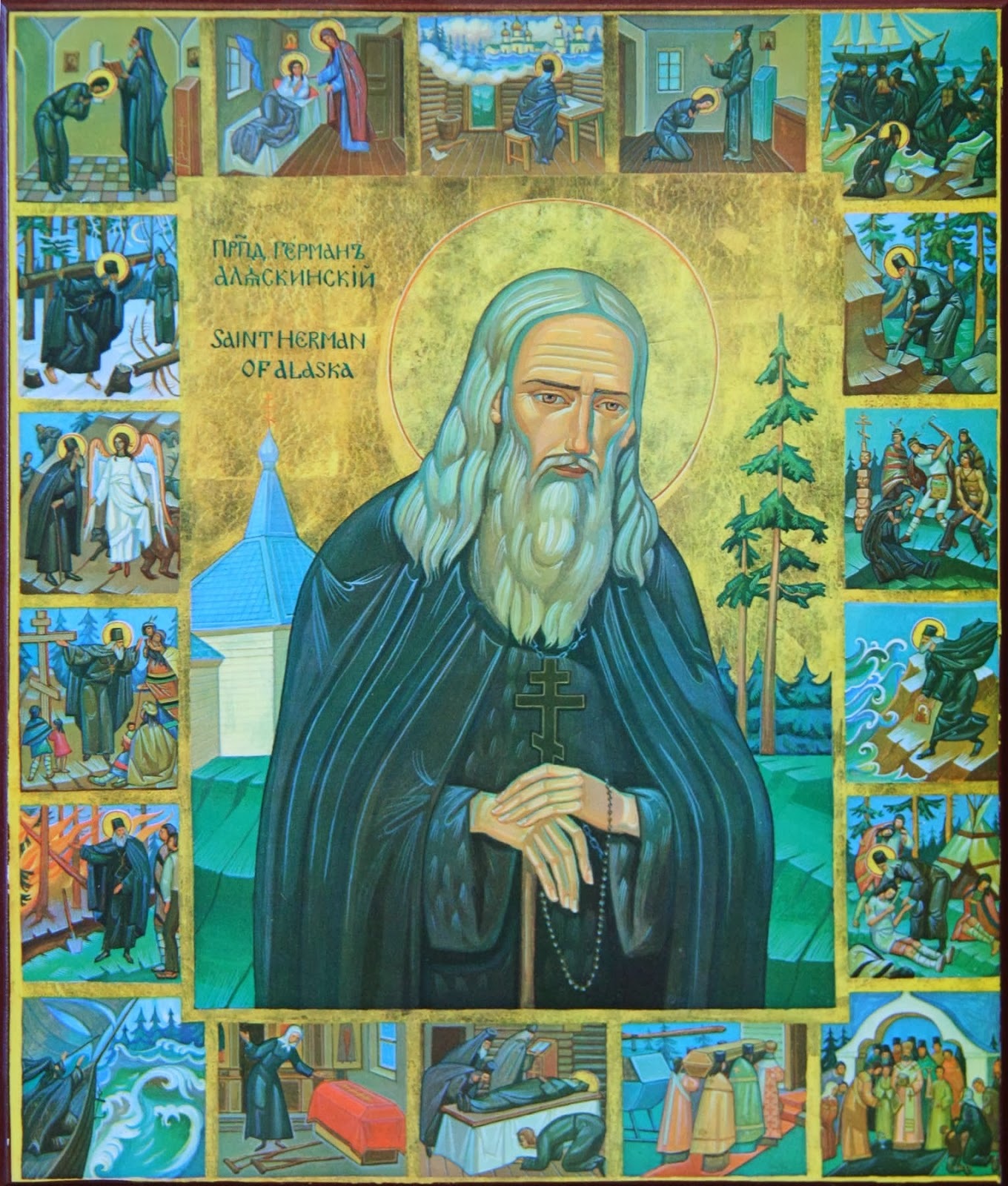
Tomorrow — August 9 — we commemorate St. Herman of Alaska.  On the one hand, there is St. Herman; and on the other hand there is Charles Manson.  What an abyss lies between the two!  What a stark contrast between light and darkness!  Or between the beauty of the image enhanced by choosing the good and the deformed ugliness of choosing evil. With St. Herman we encounter an "angel in the flesh" and with Charles Manson we encounter a "demon in the flesh."  The one embodies the "mystery of holiness" and the other the "mystery of evil."  The saint was deifed and the sinner was dehumanized.  This brings to mind the memorable words of one of Dostoevsky's most memorable characters, Dmitri Karamazov.  In grappling with the "mystery of beauty" that can deflect one from the "ideal of the Madonna" to the "ideal of Sodom," Dmitri articulates his perplexity with the following words:


No, man is broad, even too broad, I would narrow him down.  Devil knows even what to make of him, that's the thing!  What's shame for the mind is beauty all over for the heart.  Can there be beauty in Sodom?  Believe me, for the vast majority of people, that's just where beauty lies - did you know that secret?  The terrible thing is that beauty is not only fearful but mysterious. Here the devil is struggling with God, and the battlefield is the human heart.  (The Brothers Karamazov, Bk. 3, Ch. 3)


This is not the usual material that I choose for these "Fragments for Friday," but this particular story was a reminder of how the heart can wander into very dark territory.  We need our own vigilance so that the "ideal of the Madonna" always prevails over the "ideal of Sodom."  May God protect us!