Friday, April 12, 2013

'The Light of Christ Illumines All!'


Dear Parish Faithful,


“The Light of Christ illuminates all!”

At one particularly solemn point in the service of the Presanctified Liturgy, the priest turns from the altar table holding a single lit candle and the censer.  He blesses everyone present with the words: “The Light of Christ illuminates all!”  Everyone makes a prostration in order to receive this powerful blessings in an attitude of great humility and reverence.  I just came across some commentary on this blessing from Fr. Thomas Hopko in the latest issue of Life Transfigured, the journal of the Holy Transfiguration Monastery in Ellwood City, PA.  I would like to share his insightful words with all of you:

“The way to see reality in truth is in  the light of God that is revealed to the world in Christ Who illumines all things, Who enlightens everything, and Who is Himself the light of the world. And it is only in that light that we see light and it is only in that light that we see everything the way it is – beginning with our own self.”

Now here is where it gets challenging:

“When you have light, everything is seen clearly – you cannot hide anymore.  You cannot lie anymore – you cannot flee anymore. There is no way you can get away from it.  In fact, the Light of God is the torture to those who hate light.   If you do not want to see, then to see and to be forced to see is a torment.  And so Jesus says this is the judgment – that light has shone  in the darkness and there are those who love darkness more than light because their deeds are evil.  They just do not want light.

“Now when that light shines, it is painful. A lot of times we do not want to see things as they really are.  We prefer our own version of reality.  And we go around trying to get everybody to agree with us so that they can do things the way that we think they ought to be done.  Too see my own self as I really am is very painful.  But it is a miracle greater than raising the dead.  To see things clearly, to see our neighbor clearly – not to make up our own reality – that is what we want to do.

“So it is always a certain painful process to repent.  But it is also glorious – what makes life to be life:  a constant changing of our mind as it becomes more and more, deeply and fully, illumined  by the light of God who is Christ Himself.”

Wise and illuminating words!


Monday, April 8, 2013

'To Refresh Our Souls and Encourage Us'


Dear Parish Faithful & Friends in Christ,


“Before Thy Cross, we bow down in worship, O Master, and Thy Holy Resurrection, we glorify.”


The hymn above – together with the accompanying rite of venerating the Cross – replaces the usual Trisagion hymn during the Divine Liturgy on the Third Sunday of Great Lent.  According to The Synaxarion of the Lenten Triodion and Pentecostarion the full title of this mid-lent commemoration is:  “The Sunday of the Veneration of the Precious and Life-Giving Cross.”  In a wonderful commentary, The Synaxarion sets before our spiritual sight the meaning of this particular commemoration and its timing:

…The precious and Life-giving Cross is now placed before us to refresh our souls and encourage us who may be filled with a sense of bitterness, resentment, and depression.  The Cross reminds us of the Passion of our Lord, and by presenting to us His example, it encourages us to follow Him in struggle and sacrifice, being refreshed, assured and comforted. (p. 78)

Hopefully, the first three weeks of the Fast – even if we have truly “crucified the flesh with its passions and desires” (GAL. 5:24) – have not led us to experience “bitterness, resentment and depression!”  However, we could be suffering from precisely those spiritual wounds for other reasons and diverse circumstances in our lives, both external and internal.  My own pastoral experience tells me that that is probably – if not assuredly – the case.  And there is no better time than Great Lent to acknowledge this.  Such acknowledgment could lead to genuine healing if pursued in a patient and humble manner.

How, then, can we be healed?  Perhaps the Sunday of the Cross reveals our basic starting point.  The Cross of our Lord, placed before our vision, can release us from our bondage to these passions when we realize that Christ transformed this instrument of pain, suffering and death into an “emblem of victory.”  Christ has absorbed and taken our sins upon Himself, nailing them to the Cross. In the process “He disarmed the principalities and powers and made a public example of them, triumphing over them in Him” (or, in some variations, “in it,” meaning the Cross; COL. 2:15).  These “principalities and powers” continue to harass us to this day, but if we are “in Christ” then we c an actualize His victory over them and reveal their actual powerlessness.  Our lenten journey is leading us to the foot of the Cross and to the empty and life-giving tomb, and the Third Sunday of Great Lent anticipates our final goal so as to encourage us.  Again, from The Synaxarion:

As they who walk on a long and hard way are bowed down by fatigue find great relief and strengthening under the cool shade of a leafy tree, so do we find comfort, refreshment, and rejuvenation under the Life-giving Cross, which our holy Fathers “planted” on this Sunday.  Thus, we are fortified and enabled to continue our Lenten journey with a light way, rested and encouraged.  (p. 79)

Certainly none of the above is meant to deflect our attention away from the “scandal of the Cross” by poeticizing this scandal away in pious rhetoric.  We must never lose sight of the sufferings of our Lord on the Cross, and the “price” He paid to release us from bondage to sin and death.  The world in its indifference will never come to understand the enormity of Christ’s sacrifice.  So as not to lose sight of the utter horror of crucifixion as a form of capital punishment, I would like to include a passage from Martin Hengel’s book Crucifixion:

…Crucifixion satisfied the primitive lust for revenge and the sadistic cruelty of individual rulers and of the masses.  It was usually associated with other forms of torture, including at least flogging.  At relatively small expense and to great public effect the criminal could be tortured to death for days in an unspeakable way.  Crucifixion is thus a specific expression of the inhumanity dormant within men which these days is expressed, for example, in the call for the death penalty, for popular justice and for harsher treatment of criminals, as an expression of retribution.  It is a manifestation of trans-subjective evil, a form of execution which manifests the demonic character of human cruelty and bestiality. (p. 87)

So much for the “noble simplicity and greatness” of the ancient world!  But there is “nothing new under the sun” and fallen human nature is just as cruel and evil today.  Again, Christ absorbed all of that human cruelty and bestiality on the Cross.  This was a scandal, for the Son of God died the death of a slave on the Cross (PHIL. 2:8).  Now, as a “new creation” in Christ, we must of course manifest our freedom from precisely that dark and demonic abyss into which human beings can plunge; but also manifest the transfiguration of our human “energy” into the virtues that are so wonderfully revealed in the lives of the saints.  This was the prayer of the Apostle Paul when the light of the crucified and risen Lord began to shine in a world of darkness:

May you be strengthened with all power, according to his glorious might, for all endurance and patience with joy, giving thanks to the Father who has qualified us (or you) to share in the inheritance of the saints in light. He has delivered us from the dominion of darkness and transferred us to the kingdom of his beloved Son,  in whom we have redemption, the forgiveness of sins (COL. 1:14).

The Church understands and will put before our gaze the sufferings of the Lord during Holy Week.  But it is also from within the Church that we come to know the victory of Christ achieved through His death on the Cross and fully revealed in His Resurrection.  Thus the marvelous paradox of venerating a “Life-giving Cross!”  The rhetoric of the Church’s language is thereby not empty but revelatory of a mystery that has been accomplished in our midst.  The Synaxarion concludes its section on “The Sunday of the Veneration of the Precious and Life-Giving Cross” with the following prayer, a fitting way, I hope, to conclude this meditation:

“O Christ our God, through the power of the Holy Cross, deliver us from the influence of our crafty enemy and count us worthy to pass with courage through the course of the forty days and to venerate Your divine Passion and Your Life-giving Resurrection.  Be merciful to us, for You alone are good and full of love for mankind.  Amen.”

Thursday, April 4, 2013

An Orthodox Perspective on the Cross of Christ


Dear Parish Faithful and Friends in Christ,


The meditation below was recently posted on the OCA’s website.  I thought to forward it to the parish in case you would like to read it.  It is actually something that I wrote in the past, and edited a bit for the website.  The theme is in preparation for the upcoming Sunday of the Cross and, of course, it anticipates Holy Week and Pascha.

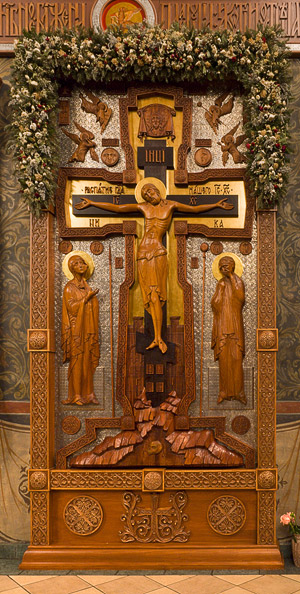
The attachment is of a very well-executed icon of the Crucifixion.

Fr. Steven

_____


An Orthodox Christian Perspective on
the Cross of Christ

by Father Steven C. Kostoff


Having come to the middle point of the path of the Fast that leads to Thy precious Cross, grant that we may see Thy day that Abraham saw and rejoiced, when on the mountain he received Isaac back alive as from the tomb. Delivered from the enemy by faith, may we share Thy mystical supper, calling upon Thee in peace: Our light and our Savior, glory to Thee!  — Matins of Wednesday in the Fourth Week of Great Lent

The misunderstanding may still persist that the Orthodox Church downplays the significance of the Cross because it so intensely concentrates on the Resurrection, or on other such themes as transfiguration, deification, mystical encounter with God, and so forth. This is an implicit criticism that there is some deficiency in the Orthodox Christian presentation of the place of the Cross in the divine dispensation “for us and for our salvation.” Such criticism may not hold up under further reflection and inspection, for the Orthodox would say that based upon the divine economy of our salvation, resurrection – and any “mystical encounter” with God – is only possible through the Cross. As this was “the purpose of his will” and “the mystery of his will” (Eph 1:5,9), our salvation could not have been accomplished in any other way. The “Lord of Glory” was crucified (1 Cor 2:8) and then raised from the dead. Elsewhere, the Apostle Paul writes that “Jesus our Lord” was “put to death for our trespasses and raised for our justification” (Romans 4:25).

The author of the Epistle to the Hebrews writes of “Jesus the pioneer and perfecter of our faith, who for the joy that was set before him endured the shame, and is seated at the right hand of the throne of God” (Heb 12:2).   A text such as this could be behind the hymn we sing at every Divine Liturgy after receiving the Eucharist: “For through the Cross, joy has come into the world.” Jesus himself said “that the Son of Man must suffer many things…and be killed and after three days rise again” (Mark 8: 31).  Of the Greek word translated as “must” from these words of Christ, Archbishop Demitrios Trakatellis wrote:

This expresses the necessity (dei) of the Messiah’s terrible affliction. Judging from the meaning of the verb (dei) in Mark, this necessity touches upon God’s great plan for the salvation of the world. (Authority and Passion, p.51-52)

Many such texts can be multiplied, but the point is clear: The Cross and the empty tomb – redemption and resurrection – are inseparably united in the one paschal mystery that is nothing less than “Good News.” Like Mary Magdalene before us, one must first stand by the Cross in sober vigilance before gazing with wonder into the empty tomb and then encountering the Risen Lord (John 20:11-18).

As something of an aside, part of this misunderstanding of the Orthodox Church’s supposed neglect of the Cross in the drama of human redemption could stem from a one-sided emphasis on the Cross in other churches at the expense of the Resurrection. The redemptive significance of the Cross somehow overwhelms the Resurrection so that it is strangely reduced to something of a glorified appendix to the salvific meaning of the Cross. As Vladimir Lossky wrote: “This redemptionist theology, placing all the emphasis on the passion, seems to take no interest in the triumph of Christ over death.”  Since the “triumph of Christ over death” is so integral to the very existence of the Church -- and since it is the ultimate paschal proclamation, as in “Christ is risen from the dead, trampling down death by death!” -- then the Orthodox Church will never concentrate on a “theology of the Cross” at the expense of the Resurrection.  Rather, the one paschal mystery will always embrace both Cross and Resurrection in a balanced manner.  Within the Church during the week of the Cross (beginning on the third Sunday of Great Lent), we sing and prostrate ourselves before the Cross while chanting:


"Before Thy Cross we bow down in worship, and Thy holy Resurrection we glorify!"

In addition, and perhaps more tellingly, the growth, development and continuing existence of certain theories of atonement that have proven to be problematic today, but not shared by the Orthodox Church, have had an impact on evaluating the Orthodox Church’s understanding of the Cross on the whole. These theories of atonement will portray God as being primarily characterized by a wrath that demands appeasement, or “propitiation,” something only the death of His Son on the Cross could “satisfy.” These theories would stress the “juridical” and “penal” side of redemption in a one-sided manner. They may also bind God to act within certain “laws” of eternal necessity that would impose such categories as (vindictive?) justice on God in a way that may obscure God’s overwhelming mercy and love.

Not sharing such theories of atonement as developed in the “West,” the Orthodox Church may face criticism for lacking a fully-developed “theology of the Cross.” However, such “satisfaction” theories of atonement are proving to be quite unsatisfactory in much of contemporary theological assessments of the meaning and significance of the Cross in relation to our salvation “in Christ."

The Orthodox can make a huge contribution toward a more holistic and integrated understanding of the role of both Cross and Resurrection, so that the full integrity of the paschal mystery is joyfully proclaimed to the world. From the patristic tradition of the Church, the voice of Saint Athanasius the Great can speak to us today of this holistic approach (using some “juridical” language!):


Here, then is the…reason why the Word dwelt among us, namely that having proved His Godhead by His works, He might offer the sacrifice on behalf of all, surrendering His own temple to death in place of all, to settle man’s account with death and free him from the primal transgression. In the same act also He showed Himself mightier than death, displaying His own body incorruptible as the first-fruit of the resurrection. (On the Incarnation, 20)

In soberly assessing too great of a dependency on juridical language when speaking of redemption, and anticipating some later theories that would narrowly focus on the language of “payment” and “ransom” in relation to the sacrifice of Christ; Saint Gregory the Theologian argued that a “price” or “ransom” was not “paid” to the Father or to Satan, as if either would demand, need or expect such a price as the “precious and glorious blood of God.” Saint Gregory says, rather, the following: 


Is it not evident that the Father accepts the sacrifice not because He demanded it or had any need for it but by His dispensation? It was necessary that man should be sanctified by the humanity of God; it was necessary that He Himself should free us, triumphing over the tyrant by His own strength, and that He should recall us to Himself by His Son who is the Mediator, who does all for the honor of the Father, to whom he is obedient in all things …. Let the rest of the mystery be venerated silently. (Oration 45,22)

However, getting it right in terms of a sound doctrine of atonement is one thing – essential as it is – but assimilating the necessity of the Cross in and to our personal understanding and the conditions of our life is another. In fact, it is quite a struggle and our resistance can be fierce! If this is difficult to understand, assimilate and then live by, the initial disciples of the Lord suffered through the same profound lack of comprehension. Their (mis)understanding of Jesus as the Messiah was one-sidedly fixated on images of glory, both for Israel and for themselves. A crucified Messiah was simply too much for the disciples to grasp, ever though Jesus spoke of this in words that were not that enigmatic. When Peter refused to accept his Master’s words of His impending passion and death in Jerusalem after just confessing His messianic stature and being blessed for it; he is forced to receive what is perhaps the most stinging rebuke in the Gospels when Jesus turns to him and says: “Get behind me Satan! For you are not on the side of God, but of men” (Mark 8:33).  It was Satan who did not want Jesus to fulfill His vocation by voluntarily dying on the Cross, so Peter’s refusal to accept Christ’s words was his way of aligning himself with Satan.

The disciples were not enlightened until after the resurrection of their Lord and Master. We are raised in the Church so that we already know of Christ’s triumph over death through the Cross. Our resistance is not based on a lack of knowledge, but of a real human dread of pain and suffering. It may be difficult to us to “see” the joy that comes through the Cross until we find ourselves “on the other side," for "now we see in a glass darkly, but then face to face” (1 Cor 13:12).  It is our hope and the “certainty” of our faith that Christ has indeed triumphed over death, “even death on a Cross” (Phil 2:8).  God has blessed us with yet another Great Lent and upcoming Holy Week and Pascha in order to share in that experience of His glorious triumph that begins with the life-giving wood of the Tree of the Cross.


Friday, March 29, 2013

Lamb of God


Dear Parish Faithful,

I was going to prepare some “fragments for Friday” this morning, but thought instead to share another fine article from Tony Vrame, Director of Religious Education of the Greek Orthodox Archdiocese.  The article has been prepared specifically for “religious educators,” but since we are always in the process of educating ourselves with the teaching of the Church as an ongoing process of enlightenment, I believe that we can all learn a great deal from what Tony shares with us below.  A good deal of this points toward Holy Week and the Passion, but we can begin to read it in preparation for the services of Holy Week still a few weeks away.

We would like to wish our Roman Catholic and Protestant friends a blessed Easter celebration as they rejoice in the Resurrection of our Lord Jesus Christ.  Believing in the bodily resurrection of Jesus is essential, and thus we share a profound foundational belief with all other Christians who continue in that belief.

Yet, after this weekend, we will be “on our own” in observing Great Lent as Orthodox Christians. This is one of those years when the gap between the Western Easter and our Orthodox Pascha is at its widest – a full five weeks.  It is important that we maintain the Lenten practices of the Church in the midst of a secular and self-indulgent culture.  Token minimalism is not sufficient or very effective in maintaining our identity within a cultural setting that finds us to be a “minority group.”

Fr. Steven


Icon of the Last Supper, by Simon Ushakov


Lamb of God

We will hear the phrase “lamb of God” as we approach Holy Week. It has deep roots in the Old and New Testaments. For Christians, it connects to theological questions about the meaning of Christ’s Passion and our salvation. The topic is huge and rich. I won’t be able to say everything here, and this is only one dimension of the questions about the Passion and salvation, but these points might encourage you to listen more closely to the Scriptures and hymns of the next few weeks.

The Old Testament background

The “sacrifice of Isaac” (Genesis 22). God tests Abraham by asking him to sacrifice his son Isaac. The test is “Is our relationship/covenant strong enough that you will honor this terrible request?” As Abraham begins the sacrifice, an angel calls out and stops him. Abraham’s willingness to make the sacrifice proves his faithfulness to God. Abraham then sees a ram, which he offers “as a burnt offering instead of his son.” (Genesis 22:13).

Passover. In the Exodus story (Exodus 12), the tenth plague was the death of every first born child. Moses instructs the Hebrew people to kill the Passover lamb (a year old male lamb without blemish; it could even be a goat) and place some of the blood on the lintel and two doorposts of their homes, so that God would “pass over” and spare the first born. (They were even instructed how to cook the lamb and that they should eat it.) Thus, Passover saved the Hebrew people from death in Egypt and this event led to their freedom and the journey to a new life in God’s promised land.

In Leviticus.  Ancient Judaism practiced animal sacrifice and offerings of other products, such as grains and fruits. The Book of Leviticus (especially chapters 1-7) provides in great detail the instructions and laws pertaining to sacrifices. Their covenant with God required this and the Law of Moses (the Law of Moses was far larger than the Ten Commandments) provided the instructions. Different kinds of offerings and sacrifices were made for various reasons. In each case, the Law prescribed what should be offered or sacrificed, what kind of animal, what kind of cereals and fruits. For example, when Joseph and Mary presented Jesus at the Temple, forty days after His birth, they offered a “pair of pigeons” (Luke 2:24), because they could not afford the lamb that the Law required as a sin offering for the birth (itself a long story, but read Leviticus 12:1-8).

While sacrifices and offerings could be made for a number of reasons, most were made as “atonement” for sins, cleansing of guilt, and the desire for forgiveness. As one person put it, atonement means “at – one – ment.” The importance of the sacrifice was the shedding of blood, meaning death. That the person making the offering also had to kill the animal was a symbolic connection between them. Sin cost a life. The penalty for sin is death, but the animal dies in the place of the sinner.

The ritual of animal sacrifice is prescribed in detail and was designed to make the connection between the sacrifice and the one making the offering. The animal is brought to the Temple by the one making the offering; he places his hand on the animal’s head, slaughters, skins, and butchers it (Remember, these were farmers and were accustomed to this, to provide food.). Usually the fatty portions are then burned on a fiery altar. The priest would sprinkle some of the blood around the altar. In some cases, the individual and or the priests of the Temple would be able to eat the remainder of the sacrifice.

This background should help as we reflect on the Passion of Christ.

 There are two timelines in the Gospels for the events from the Last Supper to the Crucifixion. The Gospel of Mark places the Last Supper on the first day of unleavened bread (Mark 14:12) when the Passover lambs would be slaughtered. The Gospel of John places Jesus’ crucifixion on the same day as the slaughter of the Passover lambs (John 19:14). The following article explains more about this.


You should begin seeing the connections to our understanding about Christ’s passion.

Jesus is a Passover lamb. That the Passion of Christ happened around Passover should not be lost on anyone. The Jews were commanded to remember the exodus from Egypt annually. Christ is without blemish, the only sinless one, and is killed like the Passover lamb. Jesus’s death and resurrection frees us from death and leads us to a new way of life in the Kingdom of God, the new Promised Land. This is why we can say Christ is the New Passover.

Jesus is the sacrifice. As He says, “For the Son of man also came not to be served but to serve, and to give his life as a ransom for many.” (Mark 10:45). Christ also says, “For God so loved the world that he gave his only Son, that whoever believes in him should not perish but have eternal life.” (John 3:16).  John the Baptist cried out when seeing Jesus, “Behold, the Lamb of God, who takes away the sin of the world!” (John 1:29). Only a lamb that is sacrificed could do this. Jesus’s death on the cross is an offering to God. God Himself makes the offering and allows His own son to be killed.

Jesus is the Suffering Servant who has accepted the fallen condition of humanity and “paid the price” for all. As the prophet Isaiah says about Him, “But he was wounded for our transgressions, he was bruised for our iniquities;upon him was the chastisement that made us whole, and with his stripes we are healed. All we like sheep have gone astray;we have turned every one to his own way; and the Lord has laid on him the iniquity of us all.He was oppressed, and he was afflicted, yet he opened not his mouth; like a lamb that is led to the slaughter,and like a sheep that before its shearers is dumb, so he opened not his mouth. (Isaiah 53:5-7).

Christians have commonly seen Christ’s death on the Cross as an “atonement.” We say Christ died for our sins and His death on the Cross saves us. But the Passover connection should remind us that the death leads to resurrection and the Resurrection of Christ opens the Kingdom of God for those who believe in Him. Salvation means being spared from death and entering the Kingdom of God.

The Church continues to use the phrase and idea “lamb of God."

In the Doxology, we praise Christ as the lamb of God who takes away the sins of the world, practically a direct quote from John 1:29.

In our liturgical life today, the bread of the Eucharist, one portion of the prosphoro is called the Amnos, the Lamb. It is marked with the ICXC NIKA, meaning Jesus Christ Conquers. Portions of the above verses from Isaiah are recited in the Proskomide service, which prepares the bread and wine before the Liturgy. The Lamb is stabbed with a lance. In the Liturgy, the lamb is offered to God and consecrated as the Body of Christ. And before Holy Communion, the lamb is broken before being placed in the chalice, and in Communion, we eat or consume the lamb.

In the Liturgy, we call the offering a “bloodless sacrifice.”  Christ’s death on the cross is the ultimate, that is, final, sacrifice or offering of blood and flesh. From now on, the only offering needed is bread and wine, done in remembrance of the Lord. Christ Himself told us to do this. This offering and shared meal is a sign of the covenant, the relationship, Christians have with God.

Anton C. Vrame, Ph.D.
Director
Department of Religious Education
Greek Orthodox Archdiocese of America

Monday, March 25, 2013

The Announcement of the Incarnation


Dear Parish Faithful & Friends in Christ,


Today, March 25, is the Feast of the Annunciation to the Most Holy Theotokos.  This great feast always falls during Great Lent, and when it falls on a weekday, is the only instance of having the full eucharistic Liturgy served for its commemoration.  Clearly a sign of the feast’s significance.  Thus, the Annunciation is something of a festal interlude that punctuates the eucharistic austerity of the lenten season.  Yet, because it does occur during Great Lent, this magnificent feast appears and disappears rather abruptly.  It seems as if we have just changed the lenten colors in church to the blue characteristic of feasts dedicated to the Theotokos, when they are immediately changed back again!  This is so because the Leavetaking of the Annunciation is on March 26.  If we are not alert, it can pass swiftly by undetected by our “spiritual radar” which needs to be operative on a daily basis.

This Feast has its roots in the biblical passage in St. Luke’s Gospel, wherein the evangelist narrates that incredibly refined dialogue between the angel Gabriel and the Virgin Mary (LK. 1:26-38).  The angel Gabriel will “announce” the joyful news of the impending birth of the Messiah, and hence our English name of “Annunciation” for the Feast.  However, the Greek title of Evangelismos is even richer in that it captures the truth that the Gospel – evangelion – is being “announced” in the encounter between God’s messenger and the young maiden destined to be the Mother of God.  Her “overshadowing” by the Holy Spirit is “Good News” for her  and for the entire world!  Even though the Feast of the Lord’s Nativity in the flesh dominates our ecclesial and cultural consciousness, it is this Feast of the Annunciation that reveals the Incarnation, or the “becoming flesh” of the eternal Word of God.  It is the Word’s conception in the womb of the Virgin Mary that is the “moment” of the Word’s enfleshment.  Hence, the Church’s insistence that a new human being begins to exist at the moment of conception. The Word made flesh – our Lord Jesus Christ – will be born nine months later on December 25 according to our liturgical calendar; but again, His very conception is the beginning of His human life as God-made-man.  The troparion of the Feast captures this well:

Today is the beginning of our salvation; the revelation of the eternal Mystery!
The Son of God becomes the Son of the Virgin as Gabriel announces the coming of Grace.
Together with him let us cry to the Theotokos:  Rejoice, O Full of Grace, the Lord is with you.


Was the Virgin Mary randomly chosen for this awesome role?  Was she compelled to fulfill the will of God regardless of her spiritual relationship with God?  Was she a mere instrument overwhelmed or even “used” by God for the sake of God’s eternal purpose?  That the Virgin Mary was “hailed” as one “highly favored” or “full of grace” (Gk. kecharitōmenē) when the angel Gabriel first descended to her, points us well beyond any such utilitarian role for her.  On the contrary, the Annunciation to the Virgin Mary  is understood and presented by the Church as the supreme example of synergy in the Holy Scriptures.  The word synergy denotes the harmonious combination and balance between divine grace and human freedom that can occur between God and human beings.  God does not compel, but seeks our free cooperation to be a “co-worker” with God in the process of salvation and deification.  In this way, God respects our human self-determination, or what we refer to as our freedom or “free will.”  It is the Virgin Mary’s free assent to accept the unique vocation that was chosen for her from all eternity that allows her to become the Theotokos, or God-bearer.  This is, of course, found in her response to the angel Gabriel’s announcement, and following her own perplexity:  “Behold, I am the handmaid of the Lord; let it be to me according to your word.”  This teaching on synergy finds its classical expression in a justifiably famous passage from St. Nicholas Cabasilas’ Homily on the Annunciation.  The passage itself is often cited as an excellent and eloquent expression of the Orthodox understanding of synergy:

The incarnation of the Word was not only the work of the Father, Son and Spirit – the first consenting, the second descending, and third overshadowing – but it was also the work of the will and faith of the Virgin. Without the three divine persons this design could not have been set in motion; but likewise the plan could not have been carried into effect without the consent and faith of the all-pure Virgin.  Only after teaching and persuading her does God make her his Mother and receive from her the flesh which she consciously wills to offer him.  Just as he was conceived by his own free choice, so in the same way she became his Mother voluntarily and with her free consent.

We praise the Virgin Mary as representing our longing for God and for fulfilling her destiny so that we may receive the gift of salvation from our Lord who “came down from heaven and was incarnate of the Holy Spirit and the Virgin Mary and became man” (Nicene Creed):

Hail, thou who art full of grace:  the Lord is with thee.
Hail, O pure Virgin; Hail, O Bride unwedded.
Hail, Mother of life: blessed is the fruit of thy womb.

(Dogmatikon, Vespers of the Annunciation)