Monday, September 16, 2013

Struggling with the Scandal of the Cross


Dear Parish Faithful & Friends in Christ,

Come, O People!  Let us fall down in worship before the blessed Tree.  (Vespers of the Exaltation/Elevation of the Cross)

On September 14, we began our festal celebration of the Feast of The Universal Exaltation of the Precious and Life-Giving Cross, to give the Feast its full title.  This feast has a full octave (Leavetaking on September 21), thus stressing the importance of the Cross in the life of the Church and in our personal lives.  It is up to us to maintain our concentration on the Cross throughout this week, and hopefully to remain vigilant in our approach to the Cross in our personal prayer life, including the veneration of the Cross within our households.  To further stress our attention toward the Cross, we recall the Third Sunday of Great Lent – the Adoration of the Cross – and the less well-observed Feast of the Procession of the Cross on August 1.  And, importantly, every Wednesday and Friday is a day of commemorating the Cross, one of the reasons that we fast on those two days on a weekly basis.

It was the Apostle Paul who already experienced the rejection of the Cross within his lifetime; and who thus anticipated this rejection throughout the centuries, when he very succinctly and profoundly captured the unbelieving world’s attitude toward the Cross in this well-known text:

For Jews demand signs and Greeks seek wisdom, but we preach Christ crucified a stumbling block to Jews and folly to Gentiles, but to those who are called, both Jews and Greeks, Christ the power of God and the wisdom of God. (I COR. 1:23-24)

This leads the Apostle to one of his most astonishing and paradoxical insights:

For the foolishness of God is wiser than men, and the weakness of God is stronger than men.  (I COR. 1:26)

The “scandal” for the Jews who were contemporary with the Apostle Paul would be the claim that the Messiah was crucified.  The “folly” for the Greek/Gentile would be the claim that the divine would even enter the realm of flesh and blood and “become” human, for it was “the Lord of glory” who was crucified according to the Apostle Paul.  As the biblical scholar Richard Kugelman put it:

The gospel message shocks Jewish nationalism and Greek intellectualism.  The Jews expected and demanded signs, i.e. spectacular miracles that showed divine intervention.  They looked for a messiah who would inaugurate their nation’s sovereignty over the Gentiles by a display of miraculous power (Mt. 12:38; 16:4; Jn. 4:48; 6:30-31).  The Greeks searched for “wisdom,” i.e., philosophies that pretended to give a satisfactory explanation of man and the cosmos.

God, in and through Christ, transformed what was shameful, weak, lowly and despised – a crucified man – into “our righteousness and sanctification and redemption.” (I COR. 1:30)  The entire passage of I COR. 1:18-31 deserves careful, close and constant study.  It remains fascinating, and highly instructive, that even non-Christians who profess to have a great respect for Jesus Christ, struggle terribly with the scandal of the Cross.  This is clearly the case with Islam.  Jesus is treated with great respect in many passages in the Qur’an – even to the point of acknowledging His virginal conception in a passage that clearly resembles the Annunciation from the Gospel According to St. Luke! (Qur’an, 3:45-47)  However, the crucifixion is treated in a way that bears no resemblance to the Gospel accounts:  “yet they did not slay him, neither crucify him, only a likeness of that was shown to them”  (4:156-159).

The Muslims believe that someone else – a figure unidentified by the Qur’an – was crucified in the plance of Christ, but not Jesus Himself. The Muslim scholar Dr. Maneh Al-Johani wrote:  “The Qur’an does not elaborate on this point, nor does it give any answer to this question.”  Clearly, the “scandal” of the Cross is too much for Muslim sensibilities, since Jesus is for them a great prophet sent by God.  Muslims further believe that Jesus was raised to Heaven, yet before He died, clearly an odd teaching that again is meant to completely distance Jesus from His crucifixion.  If there is anything agreed upon today among New Testament scholars — believers and skeptics alike — it is that Jesus of Nazareth was put to death by crucifixion by orders of Pontius Pilate in the early 30’s of the Christian era.  This lends a certain fantastic quality to these claims of the Qur’an.

There is more than a passing resemblance here with an early Christian heresy known as docetism from the Gk. word meaning “to appear.”  In other words, it only “appeared” that Christ was actually crucified and died on the Cross.  St. Ignatius of Antioch (+c. 110) vehemently rejected this heresy in its initial inception, early in the 2nd century:

Be deaf, then, when anyone speaks to you apart from Jesus Christ, who was of the family of David, who was of Mary, who was truly born, ate and drank, was truly persecuted under Pontius Pilate, was truly crucified and died … He was truly raised from the dead, when His Father raised Him up … (Epistle to the Trallians, 9)

St. Ignatius very poignantly asks:  what is the purpose of suffering martyrdom for the Lord (as he did in the Roman arena) if the sufferings of Christ were an illusion?  Should a Christian suffer in the flesh if his Lord did not?

But if, as some godless men – that is, unbelievers – say, his suffering was only apparent (they are the apparent ones), why am I in bonds, why do I pray to fight with wild beasts?  Then I die in vain.  Then I lie about the Lord.  (Trallians, 10)

Although, as Christians, we “venerate” the Cross, we do not “worship” the Cross.  We worship the One Who was crucified upon the Cross for our salvation. Indeed, with the Apostle Paul we call Him the “Lord of glory.”  Jesus Christ was not merely a prophet in a chain of prophets sent by God.  He is the fulfillment of the prophetic testimony to His coming, as He is the fulfillment of the Law. (MATT. 5:17)  We believe, as we chant in the Second Antiphon of the Liturgy, that He is the “Only-Begotten Son and Immortal Word of God … Who without change didst become man and was crucified.”  The Cross remains “an unconquerable token of victory,” an “invincible shield.”  In fact, it is for this reason that in our practice, we

Kiss with joy the Wood of salvation, on which was stretched Christ the Redeemer.  (Small Vespers)

Christianity does not exist because of what it holds in common with other great world religions, but because of what is unique and distinctive about it, primarily the Incarnation, redemptive Death, and Resurrection of Jesus Christ.  It is because of our love for Christ that beginning on the personal level, we must promote respect, tolerance, and peaceful co-existence with sincerely believing people of other religions.  I see no other way for those who claim to follow the crucified Lord of glory.  This should in no way undermine our sense of Christian distinctiveness – “And there is salvation in no one else, for there is no other name under heaven given among men by which we must be saved” (ACTS. 4:12) – but actually demonstrates our loyalty to Christ who never compels but invites with outstretched arms upon the Cross.


Monday, September 9, 2013

The Nativity of the Theotokos


Dear Parish Faithful & Friends in Christ,


The church was quite filled – and the “Communion line” was quite long – yesterday morning for the Feast of the Nativity of the Theotokos.  And Great Vespers on Saturday evening was also well-attended and therefore “festal” in nature.  Coming as it does right after the beginning of the Church New Year, this Feast allows us a good start that we further hope we can sustain as the liturgical year unfolds before us.  As a straightforward and joyous feast of commemorating the birth of the Virgin Mary, we receive a “taste” of the joyousness of life from within the Church that is often obscured by life’s challenges, difficulties and tragedies.  Fr. Alexander Schmemann puts it like this:  

In and through this newborn girl, Christ – our gift from God, our meeting and encounter with Him – comes to embrace the world.  Thus, in celebrating Mary’s birth we find ourselves already on the road to Bethlehem, moving toward to the joyful mystery of Mary as the Mother of God.

In an age of cynicism and unbelief, to encounter the purity of Mariam of Nazareth – the Virgin Mary and Theotokos – is to see life with a restored vision that, again, is only possible from within the Church.  Goodness, purity of heart and faithfulness to God are embodied realities lived by real human persons.  Such a restored vision of life will strengthen our sense of the inherent goodness of life that sin may obscure, but never obliterate.  Yet,  if  we can no longer “see” that, then we have lost something absolutely vital to our humanity, and we need to repent and embrace that “change of mind” that will restore our own humanity. 

Some will undoubtedly see nothing but a stereotype of the “feminine” here, but perhaps Fr. Schmemann has something worthwhile to say his approach to the “image of woman” as manifested in the Virgin Mary:

The Virgin Mary, the All-Pure Mother demands nothing and receives everything.  She pursues nothing, and possesses all. In the image of the Virgin Mary we find what has almost completely been lost in our proud, aggressive, male world:  compassion, tender-heartedness, care, trust, humility.  We call her our Lady and the Queen of heaven and earth, and yet she calls herself “the handmaid of the Lord.”  She is not out to teach or prove anything, yet her presence alone, in its light and joy, takes away the anxiety of our imagined problems.  It is as if we have been out on a long, weary, unsuccessful day of work and have finally come home, and once again all becomes clear and filled with that happiness beyond words which is the only true happiness.  Christ said, “Do not be anxious … Seek first the Kingdom of God” (see Mt. 6:33).  Beholding this woman – Virgin, Mother, Intercessor – we begin to sense, to know not with our mind but with our heart, what it means to seek the Kingdom, to find it, and to live by it.  —Celebration of Faith, Vol. 3

On the day following the Feast – in this case today, September 9 – we commemorate the “ancestors of God,” Joachim and Anna, the father and mother of the Virgin Mary according to the Tradition of the Church.  This is a consistent pattern within our festal and liturgical commemorations:  On the day after a particular feast, we commemorate the persons who are an integral part of that feast day’s events.  For example, the day after Theophany we commemorate St. John the Baptist; and on the day after Nativity, we commemorate the Theotokos.  Therefore, because of the essential role of Joachim and Anna in the current Feast of the Virgin Mary’s Nativity, today is the “synaxis of Joachim and Anna”  and we thus bring them to mind in an effort to  discern and meditate upon their important place in this festal commemoration.

The source of their respective roles is the Protoevangelion of James, a mid 2nd c. document.  As Archbishop Ware has written:  

The Orthodox Church does not place the Protoevangelion of James on the same level as Holy Scripture:  it is possible, then, to accept the spiritual truth which underlies this narrative, without necessarily attributing a literal and historical exactness to every detail. 

One of those “spiritual truths” alluded to by Archbishop Ware is the account of both Joachim and Anna continuing to pray with faith and trust in God’s providence even though they were greatly discouraged over the “barrenness” of Anna.  A lack of children in ancient Israel could easily be taken for a sign of God’s displeasure, thus hinting at hidden sins that deserve rebuke. Though disheartened, they continued to place their trust in God, refusing to turn away from God though thoroughly tested as to their patience.  Perseverance in prayer in the face of discouragement is a real spiritual feat that reveals genuine faith.  The conception and then birth of the Virgin Mary reveals to joyous outcome of their faith and trust in God.  Perhaps this is why we commemorate Joachim and Anna as the “ancestors of God” at the end of every Dismissal in our major liturgical services, including the Divine Liturgy:  We seek their prayers as icons of an everyday faith that is expressed as fidelity, faith and trust in God’s Law and providential care.

Joachim and Anna could also be witnesses to a genuine conjugal love that manifests itself in the conception and birth of a new child.  Their union is an image of a “chaste” sexual love that is devoid of lust and self-seeking pleasure.  The strong ascetical emphases of many of our celibate saints may serve to undermine or obscure the blessings of conjugal love is envisaged in the Sacrament of Marriage.  In fact, through its canonical legislation going back to early centuries, the Church has struggled against a distorted asceticism that denigrates sexual love even within the bonds of marriage as a concession to uncontrollable passions.  The Church is not “anti-sex.”  But the Church always challenges us to discern the qualitative distinction between love and lust.  The icon of the embrace of Joachim and Anna outside the gates of their home as they both rush to embrace each other following the exciting news that they would indeed be given a child, is the image of  this purified conjugal love that will result in the conception of Mary, their child conceived as all other children are conceived.

The Feast of the Nativity of Our Most Holy Lady the Theotokos has four days of Afterfeast, thus ending with the Leavetaking on September 12.  That allows us to then prepare for the Feast of the Elevation of the Cross on September 14!


Friday, August 30, 2013

The 'Two Ways' and the Church New Year


Dear Parish Faithful & Friends in Christ,

The Spirit of the Lord is upon me … to  proclaim
the acceptable year of the Lord.”   (LK. 4:18-19)

The beginning of the Church New Year occurs on September 1.  This is also referred to as the Indiction, and there are both religious and political reasons behind this date, as the Church was accommodating itself to the realities of a Christianized Roman Empire by the fourth century. This year September 1 will coincide with the Tenth Sunday After Pentecost, and so it is only a two days away from now.  Though hardly commemorated today with much attention, the fact that it will fall on the Lord’s Day this year may bring to the ecclesial New Year a bit more attention than usual.  Living as we do in a completely different and secularized society from the Roman/Byzantine world in which our church calendar was more-or-less fully developed, we have a difficult time conceiving of any new year commemoration other than that of January 1.  Be that as it may, if we want to understand the liturgical year with its developed rhythm of feasting and fasting, we will need to embrace “the mind of the Church” to some extent to make that understanding attainable.  As Orthodox Christians we live according to the rhythms of two calendars – the ecclesial and the secular – and often enough we are caught up in a “battle of the calendars.”  That is a struggle that can strain our choices and possibilities when we make decisions that affect the use of our “time, talent and treasure.” The appointed Gospel reading for the Church New Year is LK. 4:16-22, from which the scriptural text above is taken.  Every year is potentially “the acceptable year of the Lord,” but from our all too-human perspective that will be determined by how we approach each year as it comes to us in our appointed time in this world.

Recently, but with a more focused intention, I applied two contrasting terms toward our approach to the Dormition Fast that occupied us at the beginning of August for two weeks. Those contrasting terms were convenience and commitment.  I said that our approach to this recent fast was  determined by our choice of seeking the way of convenience or of making a commitment.  A choice of convenience will lead to being uncommitted and thus negligent of whatever discipline is set before us.  I believe that we can expand the use of these terms to now embrace our approach to the Church New Year or even beyond to our very approach to life as Christians.  As we approach the Church New Year we can ask ourselves:  Do I choose convenience over commitment when these terms apply to my relationship to God and with the Church? ?  Is my first concern when the “distribution” of my time, talents and treasure is under consideration reduced to a matter of convenience; or do I first think in terms of my commitment to the Lord?   Am I therefore trying to “fit” the Church into my life rather than trying to “fit” my life into the fullness of life offered in the Church?  At the beginning of the Church New Year on Sunday – a beginning that not only implies, but offers the gifts of repentance, renewal and regeneration – these may be questions worthy of our heartfelt and serious consideration.

It may seem too simplistic to ask these questions in a stark “either/or” manner.  Life is a bit more complicated than that.  The choices of convenience and/or commitment – made consciously or unconsciously - can be seen as relative terms that often overlap and get entangled in ways that only further accentuate life’s complexities.   Nevertheless, with the utter seriousness with which the Scriptures confront us with the “God question” we do find set before us a rather stark choice between “two ways:”  and that would be between life and death.  These are not choices that impinge upon our biological well-being.  Rather, “life” and “death” are choices that depend upon our commitment to not only believing in God’s existence, but of our willingness to live according to the commandments of God.  That is why the choice is presented in a very straightforward, unambiguous manner.  The stakes are that high.  It is not as if the teaching found in the Scriptures lacks an awareness of the difficulties of life; or of what we like to refer to as life’s “nuances.”  But in the Scriptures we find the “ultimate questions” presented with a clarity that, again, demands a clear choice with a full understanding of just what is at stake.  For ultimately, there is an “either/or” distinction when it comes to our decision for or against God.

The term “Two Ways” was from the beginning of the Church’s life even a technical term found in the earliest Christian literature.  Although not a part of the New Testament, this is perhaps best illustrated by the very early document (1st. c.) known as The Didache.  This document opens with a classic expression of this teaching:

There are two ways: one is the Way of Life, the other is the Way of Death; and there is a mighty difference between these two ways. 
The way of life is this:  first, that you shall love God who created you; second, your neighbor as yourself; all those things which you do not want to be done to you, you should not do to others. (Didache, 1:1-2)

This clearly echoes the direct teaching of Christ found in the Gospels, of course.  And in the Gospel According to St. Matthew, we hear the Lord’s own versions of this choice of the Two Ways:

Enter by the narrow gate; for the gate is wide and the way is easy, that leads to destruction, and those who enter by it are many.  For the gate is narrow and the way is hard, that leads to life, and those who find it are few.
Every one then who hears these words of mine and does them will be like a wise man who built his house upon the rock; and the rain fell, and the floods came, and the winds blew and beat upon that house, but it did not fall, because it had been founded on the rock.  And every one who hears these words of mine and does not do them will be like a foolish man who built his house upon the sand; and the rain fell, and the floods came, and the winds blew and beat against that house, and it fell, and great was the fall of it.  (MATT. 7:13-14;24-27)

Yet, the Christian teaching of the Two Ways finds its first and most definitive expression in the Old Testament.  There, as something of a final summation of the lengthy discourse of Moses to the people of Israel before they enter the Promised Land, the following is recorded in the Book of Deuteronomy:


But the word is very near you; it is in your mouth and in your heart, so that you can do it. See, I have set before you this day life and good, death and evil.  If you obey the commandments of the LORD your God which I command you this day, by loving the LORD your God, by walking in his ways, and by keeping his commandments and his statutes and his ordinances, then you shall live and multiply, and the LORD your God will bless you in the land which you are entering to take possession of it.  But if your heart turns away, and you will not hear, but are drawn away to worship other gods and serve them, I declare to you this day, that you shall perish; you shall not live long in the land which you are going over the Jordan to enter and possess.  (DEUT. 30:14-18)

The Church calendar with its New Year commemoration on September 1 can be more than a quaint and antiquated remnant from the past.  And it can even be more than a formal reminder that we will begin the annual cycle of feasting and fasting by celebrating the great Feasts of the liturgical year – important as this is.  The Church New Year, perhaps coming after a long and “busy” summer, can remind us with a biblical urgency that the choice of the Two Ways may not be a once-in-a-lifetime decision; but one that needs annual renewal that can only be accomplished through repentance and that “change of mind” that directs us toward God with all of our heart, soul, mind and strength (MK. 12:30).  Let us search our hearts about this carefully.  This deserves our time and attention more than anything else.  This is not an inner examination that can be postponed to a more “convenient” time.  Rather, it is a time of “commitment” to the really essential question that shapes our lives decisively.  As the Lord asked the Apostle Peter, so the Lord asks us if we love him. Are we able to answer Him as did St. Peter: “Lord, you know everything; you know that I love you.”  (JN. 21:17)


Friday, August 23, 2013

The 'Image of God' in Man


From Fr. Thomas Hopko:

Sometimes the “image of God” in humans is identified with their spirit, soul, or mind.  This is misleading and inaccurate.  Humans are made “according to God’s image and likeness” to have divine qualities, and so to be and act as God is and acts, in the wholeness of their humanity.  To be and act in a divine manner, humans must first of all be spiritual (pneumatikos, noetikos, logikos).  But they must also be psychic and bodily, in male and female forms.  The spirit/pneuma (or mind/nous or word/logos) is to govern a person’s soul and body with their emotions and passions.  If the “spirit” alone were God’s image in creatures, then bodiless powers, i.e. angels, and not human beings, would be made “according to God’s image and likeness.” 

We must note here as well that God is not “a spirit.”  God is completely different (totaliter aliter) from creatures in every way.  To refer to God as “spirit” is as anthropomorphic as to speak of God’s eyes or hands.  In St. John’s Gospel, Jesus says “God is Spirit” to indicate that God is not located anywhere, and must be worshipped “in spirit and truth” (John 4:24).  The Lord here is not making a metaphysical statement about God’s being, which, according to the Orthodox church fathers’ interpretation of the Bible, as well as their personal mystical experience, is “beyond being [hyperousios]” and even “beyond divinity [hypertheos]”.”

The Orthodox patristic teaching is that humans, to be truly human, are to be by God’s grace (kata charin theou), good will (kat’ evdokian), action (kat’ energeian), and power (kata dynamin) everything that God Himself is by nature (kat’ ousian).  Their creaturely constitution as spiritual, psychic, and bodily beings make this deification possible.”

From Christian Faith and Same-Sex Attraction, p. 19.

Wednesday, August 14, 2013

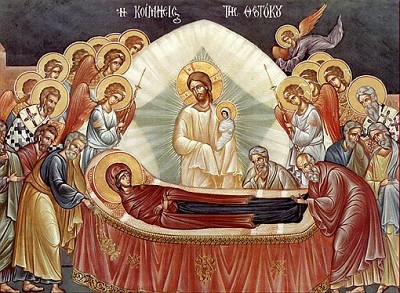
The Feast of the Dormition and Dying a 'Deathless Death'


Dear Parish Faithful,

Just a reminder that we will celebrate the Feast of the Dormition of the Theotokos this evening with the Vesperal Liturgy, beginning at 6:00 p.m.  I am eagerly anticipating a church filled with worshippers as we commemorate the falling asleep of the Virgin Mary and her translation to the Kingdom of God.  This will end the two-week Dormition fast that has prepared us for the feast.

The Feast of the Dormition clearly raises the issue of death and dying, and what we mean by a “Christian ending to our life.”  For the moment, though, here is a challenging paragraph from Fr. Thomas Hopko about some of our own misconceptions – basically our fears – that often find us wandering far from an Orthodox approach to death and dying:

I believe that the issue of death and dying is in need of serious attention in contemporary Orthodoxy, especially in the West, where most members of the Church seem to be “pagan” before people did and “Platonists” afterwards.  By this I mean that they beg the Church to keep people alive, healthy, and happy as long as possible, and then demand that the Church assure them after people die that their immortal souls are “in a better place, basking in heavenly bliss” no matter what they may have done in their earthly lives.  —  From Christian Faith and Same-Sex Attractions, p. 89, note 2.

To add a bit more to this, here is a passage from Bp. Ilarion Alfeyev, that reinforces the Christian understanding – and hope – that accompanies us at the moment of death:

For the non-believing person, death is a catastrophe and a tragedy, a rupture and a break.  For the Christian, though, death is neither a catastrophe nor something evil.  Death is a “falling asleep,” a temporary condition of separation from the body until the final unification with it.  As Isaac the Syrian emphasizes, the sleep of death is short in comparison with the expectant eternity of a person.  — From Orthodox Christianity, Vol. 2, p. 496.

St. Gregory of Nyssa states this Christian hope with clarity:

By the divine Providence death has been introduced as a dispensation into the nature of man, so that, sin having flowed away at the dissolution of the union of soul and body, man, through the resurrection, might be refashioned, sound, passionless, stainless, and removed from any touch of evil.  – Great Catechetical Oration, 35.

This is precisely why we can call the Feast of the Dormition of the Theotokos, “pascha in the summer!”   The Virgin Mary and Theotokos died a “deathless death.”  Now we have the opportunity to participate in this mystery in the celebration of this event as nothing less than a Feast.  Looking forward to seeing you this evening!